
I. What is BOIÚNA? Why is this New Solana Coin Suddenly Drawing Attention?
BOIÚNA is a new meme asset that has recently emerged on the Solana ecosystem. For users searching "what is BOIÚNA" or "what coin is BOIÚNA" for the first time, the most critical first step is not to predict whether it will go up, but to clearly define its asset class.
More precisely, BOIÚNA is best defined as a Solana meme coin at this stage, not as a verified utility token or a revenue-generating project token.
As of August 14, 2026, CoinGecko has listed the Boiúna page, categorizing it under Solana Ecosystem and Pump.fun Ecosystem. The page displays its contract information, trading markets, price, market cap, and 24-hour trading volume. CoinGecko shows BOIÚNA's price at approximately $0.0001493, with a circulating supply of 1 billion tokens, a market cap of roughly $143,600, an FDV of about $143,600, and 24-hour trading volume of approximately $5.017 million.
This data alone explains why BOIÚNA merits a closer look: a new meme asset with a market cap in the low six figures, yet generating millions in volume within hours. That doesn't necessarily mean millions in long-term capital has entered—it could also indicate extreme turnover, bot activity, short-term speculation, or volatile price discovery.
Therefore, the core question for BOIÚNA isn't "Is it the next BONK?" but rather:
Is BOIÚNA's trading heat driven by genuine community demand, or is it a high-turnover phenomenon manufactured by short-term capital, bots, and meme sentiment?
II. What Does Boiúna Mean? How Did an Amazonian "Black Snake" Become a Meme Coin?
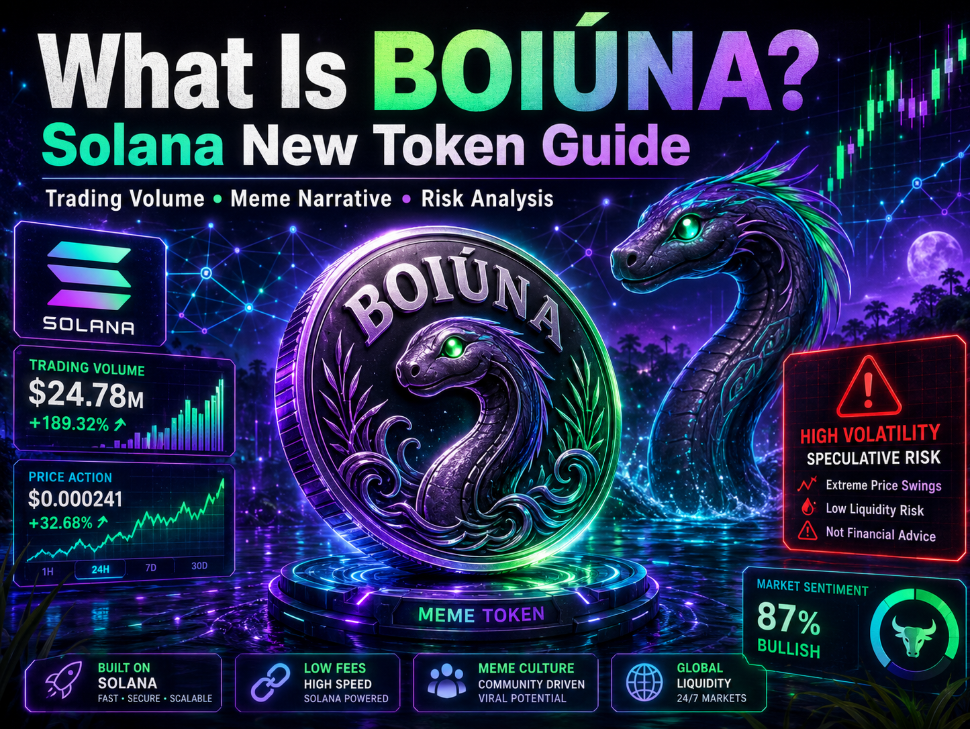
The name BOIÚNA isn't entirely random. In Brazilian and Amazonian mythology, Boiúna is commonly interpreted as a "black snake," also known as Cobra Grande, meaning "great snake" or "giant serpent." Various sources describe Boiúna as a widely circulated mythical figure in the Amazon basin, with "boi" referring to snake and "una" meaning black—hence "black snake."
In Brazilian folklore, Cobra Grande or Boiúna is a massive serpentine creature dwelling deep in rivers and lakes. There are many versions of the legend, with different interpretations across Amazonas, Pará, Tocantins, Roraima, and other regions. Toda Matéria also notes that Cobra Grande, also called Boiuna, is a highly popular legendary figure in northern and northeastern Brazil.
Why do such mythological animals easily transform into meme assets?
Because crypto meme propagation typically relies on four elements: a strong visual symbol, a simple story, an easy-to-remember name, and room for community remixing.
DOGE is a dog.
PEPE is a frog.
MOODENG is an animal trend.
BOIÚNA bets on snakes, Amazonian mythology, the black serpent, and Latin American cultural symbolism.
But a crucial point: The existence of a cultural story doesn't automatically give the token fundamental value. The Boiúna myth can fuel meme marketing, but whether the BOIÚNA token sustains upward momentum still depends on liquidity, holder growth, community reach, trading structure, and risk management.
III. BOIÚNA Should Be Understood as a Narrative Asset, Not a Revenue Token
For newcomers, don't frame BOIÚNA as a "tech project." Based on current public data, a more accurate definition is:
BOIÚNA is a meme asset built around the Boiúna cultural symbol, operating within Solana's meme ecosystem and the Pump.fun new-coin trading environment. Its short-term value is primarily driven by narrative, attention, community spread, trading volume, and liquidity.
It is closer to:
- Narrative Asset
- Meme Coin
- New Solana Coin
- Pump.fun Ecosystem Asset
- Early-stage Price Discovery Asset
It should not be mistaken for:
- A mature protocol token
- A utility token backed by revenue
- A verified Web3 project with a proven business model
This distinction is critical. If you evaluate BOIÚNA through a "project valuation" lens, you'll find scarce fundamental data. But if you analyze it through an "early-stage meme trading" lens, the key variables become volume, unique traders, holder addresses, liquidity, social traction, and contract risk.
IV. Before Buying: Why You Must Verify the Contract Address First
One of the most dangerous pitfalls in Solana meme coins is the proliferation of copycat tokens and fake versions.
BOIÚNA is no exception. Search results already show multiple Pump.fun pages using the BOIÚNA name. For instance, one page shows "Boiúna," another shows "BEWARE BOIÚNA," corresponding to different Pump.fun tokens. Pump.fun's own interface warns that anyone can create tokens, prices can fluctuate rapidly, and trading requires caution.
This highlights a golden rule:
Ticker ≠ Token Identity.
Seeing the name "BOIÚNA" doesn't prove you're buying the same coin that's being discussed in the market, tracked by CoinGecko, and generating high volume.
What you must verify is the Mint Address—the token's contract address on Solana. CoinGecko shows the Boiúna contract as "GRehQ...kGpump," categorized under Solana Ecosystem and Pump.fun Ecosystem. Solscan also confirms that address corresponds to the token named Boiúna.
Before buying BOIÚNA, verify at least five things:
- Does the Mint Address match the one on major data pages?
- Does the creation time align with the coin currently under discussion?
- Is the primary liquidity pool the one with the highest volume?
- Does the official X, Telegram, or community channel reference the same contract?
- Is the trading page connected to the genuine main pool, not a fake pool with the same name?
For new meme coins, buying the wrong contract is far more dangerous than buying at a high price. If you overpay, you might still cut losses—but buying a fake token can leave you unable to exit at all.
V. Why Did BOIÚNA Suddenly Post Such High Trading Volume?
BOIÚNA's most eye-catching feature is the stark divergence between its Volume and Market Cap.
Based on CoinGecko data, BOIÚNA's market cap is around $143,600, while its 24-hour volume is approximately $5.017 million. That means the 24-hour volume is roughly 35 times the market cap.
This isn't uncommon among new Solana memes, but it's a major red flag.
Volume does not equal long-term capital inflow.
For example, the same $10,000, if traded repeatedly by high-frequency traders, bots, arbitrage wallets, and short-term players, can generate hundreds of thousands or even millions in volume.
Thus, BOIÚNA's high volume could stem from four scenarios:
- Genuine price discovery – A new coin being discovered, with buyers and sellers rapidly entering to reprice it.
- High short-term trader activity – Many addresses flipping quickly with no intention of holding.
- Bot participation – Solana's low fees and fast speeds make it ideal for automated trading and front-running.
- Wash trading or repetitive trades – A small set of wallets trading back and forth to inflate volume.
So, seeing high volume for BOIÚNA shouldn't lead you to conclude "many people are bullish." You need to dig deeper into the quality of that volume.
VI. How to Interpret BOIÚNA's Volume / Market Cap Ratio?
Volume / Market Cap is a critical metric for early-stage meme coins.
Simple formula:
Volume / Market Cap = 24h Trading Volume ÷ Current Market Cap
If Market Cap is $150,000 and 24h Volume is $5 million, the ratio is roughly 33x to 35x.
What does that tell you?
It means the token's daily turnover far exceeds its current valuation.
That could be good—or bad.
Bullish scenario: BOIÚNA is in a price discovery phase, with the market yet to settle on a valuation, as fresh capital and traders test price levels.
Bearish scenario: The volume is driven by high-frequency bots, arbitrage, repeated trades from the same cluster of wallets, or extreme attention-driven churn.
For newcomers, don't stop at "volume is high." Instead, ask:
- How many unique trading wallets are there?
- Are new holder addresses increasing?
- Are buy addresses outnumbering sell addresses?
- Is net buying volume positive?
- Is liquidity growing in tandem?
- Are large holders distributing during high volume?
If you can't answer these, higher volume should actually make you more cautious.
VII. Is BOIÚNA's Volume Genuine Heat or Bot-Generated?
Judging the quality of BOIÚNA's volume requires looking beyond the single Volume figure to on-chain structure.
First indicator: Unique Traders – the number of distinct wallet addresses trading. If volume is high but unique wallets are few, it suggests a small group trading repeatedly.
Second: Transaction Count – high transaction count doesn't guarantee genuine demand, but it helps gauge activity levels.
Third: Buyers vs. Sellers – if buy wallets are consistently growing while sell wallets aren't rising proportionally, new capital may be entering. Conversely, if buys and sells are almost symmetrical, it's mostly churn.
Fourth: Buy Volume vs. Sell Volume – if sell volume persistently outweighs buy volume even when total volume is high, price will face pressure.
Fifth: Repeat Trading – if the same wallets are buying and selling the same token repeatedly within short windows, suspect bots or arbitrage.
Why is checking for bots especially important for new Solana coins?
Because Solana's low transaction costs, high speed, and vibrant DEX ecosystem attract snipers, MEV bots, arbitrageurs, wash-trading bots, and copy-traders right after a new coin launches. Pump.fun, as a meme launchpad, explicitly warns that anyone can create tokens and prices can swing wildly.
So for BOIÚNA, high volume does not automatically prove high organic demand.
True, valuable heat should be reflected in more unique wallets, a growing holder base, deeper liquidity, and sustained community discussion.
VIII. Liquidity Matters More Than Market Cap for BOIÚNA
Many newcomers see BOIÚNA's market cap at just over $100,000 and think, "This is a tiny cap—a small buy could send it to the moon."
But the first thing you should check is Liquidity.
Market Cap is not the money you can withdraw.
If a token shows a $500,000 market cap but only $30,000 in the liquidity pool, a few thousand dollars in sales can cause significant slippage. The price you see is the current order-book price—it doesn't mean you can exit at that price smoothly.
When analyzing BOIÚNA, focus on:
- Total liquidity amount
- SOL liquidity
- Token liquidity
- The largest LP provider
- Whether the LP is locked or burned
- Estimated slippage for selling $100, $1,000, or $5,000
- Whether liquidity has increased as price rises
A healthy new meme shouldn't just see price increases and volume spikes—it should also see deepening liquidity. If market cap rises quickly but liquidity stagnates, the price is easily pumped by small capital and easily crashed by whales.
IX. Is BOIÚNA's Holder Distribution Safe?
Judging BOIÚNA's safety isn't just about looking at the price chart—you need to examine Holder Distribution.
Key metrics: Top 1, Top 5, and Top 10 holder percentages. If a few addresses hold a massive share (excluding LP, burn, or exchange wallets), sell pressure risk is extremely high.
But avoid a common mistake: don't simply count the LP address as a "whale."
When analyzing holdings, exclude:
- Liquidity Pool addresses
- Burn Addresses
- Exchange or aggregator wallets
- Known contract addresses
Without filtering these, top-holder data can be seriously misleading.
For new Solana memes, also check for Bundle and Sniper risks. Snipers are bots that buy early at launch; bundles are clusters of related wallets buying simultaneously. If these wallets have extremely low cost bases and later dump collectively, retail traders become exit liquidity.
Therefore, BOIÚNA's safety depends not on whether the name is catchy, but on whether the holder structure is decentralized, early allocations are transparent, LP is stable, and permissions are secure.
X. Why Does BOIÚNA Go Up? Breaking Down the 7 Core Variables Behind Meme Coin Prices
BOIÚNA's price appreciation typically isn't due to "fundamental improvements" but rather a confluence of multiple meme-market variables.
1. Meme Propagation Speed – X, Telegram, TikTok, Discord, and community remixes directly affect attention.
2. KOL Endorsements – When major accounts, meme community handles, or Solana Alpha voices start discussing it, short-term buying increases noticeably.
3. Unique Holder Growth – Compared to raw volume, holder address growth better indicates new user adoption.
4. Liquidity Growth – Only with deepening liquidity can price increases become more sustainable.
5. Smart Money Entry – If historically profitable wallets begin accumulating, it attracts copy-trading—but beware of smart money dumping early.
6. SOL Price Environment – The typical Solana meme trading path is USDT/USDC → SOL → meme token. When SOL rises, on-chain wealth effects strengthen, and meme trading activity tends to increase. You can monitor SOL Real-Time Price and SOL Price Prediction to gauge risk appetite in the Solana ecosystem.
7. Overall Crypto Risk-On Environment – When BTC and ETH are strong, markets are more willing to take risks, and small-cap memes attract more capital. Check BTC Price Prediction and ETH Price Prediction to assess the broader macro environment.
Simply put, BOIÚNA's upward movement isn't fundamentally about "the snake story is strong"—it's about short-term resonance among attention, capital, on-chain activity, and liquidity.
XI. Why SOL's Price Trend Is Especially Important for BOIÚNA
BOIÚNA is a meme asset within the Solana ecosystem, so its relationship with SOL is tight.
The typical Solana meme trading path:
- USDT or USDC into wallet
- Swap to SOL
- Buy meme via PumpSwap, Meteora, or other DEXs
When SOL rises, on-chain users see their net asset value increase, risk appetite grows, and meme trading often heats up.
When SOL drops sharply, the opposite happens: users de-risk first, and illiquid small-cap memes tend to fall even harder than SOL.
So, BOIÚNA investors can't just watch BOIÚNA's own chart. You also need to track whether SOL is strong, whether Solana memes as a whole are active, and whether Pump.fun new coins are continuing to gain traction.
When SOL is strong, the meme sector is hot, BOIÚNA's holder count is rising, and liquidity is increasing, the short-term trading environment for BOIÚNA improves.
When SOL is weak, the broader market is falling, meme volumes are shrinking, and BOIÚNA shows only volume without new holders, risks escalate significantly.
XII. How Does BOIÚNA Differ from Solana Memes Like BONK, WIF, and POPCAT?
Many newcomers see that Solana has produced BONK, WIF, and POPCAT and naturally assume BOIÚNA might follow a similar path.
That assumption is dangerously flawed.
BONK, WIF, and POPCAT are established, mature meme assets. They typically have deeper liquidity, larger market caps, more holders, broader exchange support, and longer-term community staying power.
BOIÚNA currently belongs in the early-stage meme category.
Its characteristics:
- Still in early price discovery
- Small market cap
- Possibly limited liquidity
- Narrative not yet tested over time
- Holder structure needs ongoing observation
- Upside potential and rug risk are both very high
The success of mature memes only proves that Solana has a meme speculation culture and wealth-effect dynamics—it does not imply BOIÚNA will also succeed.
The real question is: Can BOIÚNA transition from a "short-term volume spike new coin" to a "sustainable community asset"?
XIII. How Much Higher Can BOIÚNA Go? Don't Focus on the Per-Token Price—Look at Market Cap
When forecasting BOIÚNA's price, avoid making bold claims like "it will hit $0.01 in 2026." For meme coins, a more professional approach is Market Cap Scenario Analysis.
Formula:
Target Price = Target Market Cap ÷ Token Circulating Supply
CoinGecko shows BOIÚNA's circulating, total, and max supply are all 1 billion tokens. Assuming supply stays at 1 billion, you can back-calculate price from market cap.
- If BOIÚNA reaches a $1 million market cap, the price is approximately $0.001.
- If it reaches $10 million, the price is about $0.01.
- If it reaches $100 million, the price is around $0.1.
But the key question is: Why would it reach those market caps?
- $1 million might require only short-term meme hype and modest liquidity.
- $10 million would need many more holders, stronger social reach, deeper liquidity, and multiple trading venues.
- $100 million would require entering the mainstream Solana meme conversation, building a lasting community, a strong brand symbol, and cross-platform demand.
So, BOIÚNA's upside shouldn't be judged solely by "the price is low now"—it depends on whether it can convert short-term volume into sustainable community and real liquidity.
XIV. The Biggest Trap in BOIÚNA's High Volume: Volume Illusion
One of the most common pitfalls with coins like BOIÚNA is Volume Illusion.
Volume Illusion means the trading activity looks extremely robust, but the actual sustainable buy-side demand is much weaker than the volume suggests.
It can come from:
- High-frequency bots
- Arbitrage trades
- Snipers entering and exiting repeatedly
- Wash trading
- The same cluster of wallets trading back and forth
- Short-term flippers churning positions
Therefore, Volume should be evaluated alongside five other metrics:
- Unique Traders – More unique traders = higher-quality volume.
- Holder Growth – Rising holder counts suggest trading heat may be converting into community.
- Liquidity – High volume with shallow liquidity signals high exit risk.
- Net Buy Flow – Sustained positive net buy inflow is needed to support price.
- Top Holders – The more concentrated large holders are, the greater the dump risk.
BOIÚNA's most important research question right now isn't "how large is the 24h volume?" but rather: Is there real new capital, new wallets, and new community behind that volume?
XV. The 8 Biggest Risks of Investing in BOIÚNA
- Rug Pull Risk – If the project team or early controllers withdraw liquidity, the price can collapse instantly.
- Holder Concentration Risk – If top holders own too much, a concentrated sell-off can leave retail unable to exit.
- Low Liquidity Risk – Displayed price ≠ actual execution price, especially for larger orders where slippage can be extreme.
- Bot Trading Risk – Bots are common on Solana new coins; high volume may be artificial.
- Copycat Token Risk – Multiple tokens with the same or similar names exist; buying the wrong contract may make it impossible to sell.
- Meme Narrative Risk – The Boiúna myth is shareable, but meme hype can fade as quickly as it appears.
- Token Permission Risk – Check mint authority, freeze authority, LP status, and contract security.
- Extreme Volatility Risk – New memes can surge 300% in a day and drop 90% shortly after—this is not unusual.
Thus, BOIÚNA is unsuitable for a "long-term value investment" framework. It's better viewed as an extremely high-risk early-stage meme trading vehicle.
XVI. Is BOIÚNA Worth Buying? Use 7 Data Points, Not Emotions
Whether BOIÚNA is worth buying shouldn't be decided by community shills or a single day's pump.
A more reasonable framework looks at seven data points:
- Is the holder count consistently growing?
- Are unique traders consistently growing?
- Is liquidity growing in tandem?
- Is volume coming from many unique wallets, not just a few repeat addresses?
- Are top holders overly concentrated?
- Can community heat sustain for 24–72 hours, not just a few hours?
- When market cap rises, does liquidity keep up?
For an early-stage meme like BOIÚNA, the most important thing to track isn't any single candle—it's whether this conversion chain is sustained:
Attention → New Wallets → New Capital → Liquidity
If there's only attention but no new wallets, hype may fade quickly.
If there are new wallets but no liquidity, price will swing violently.
If there's volume but no holder growth, it's likely just short-term capital feeding on itself.
If market cap rises while top holders keep selling, be highly alert.
XVII. If You Trade BOIÚNA, What Should Newcomers Pay Most Attention To?
If you still decide to trade BOIÚNA, follow these steps at minimum:
Step 1: Confirm the unique Mint Address. Don't rely on ticker, logo, or links shared in groups.
Step 2: Confirm the primary liquidity pool. Check where the highest volume is—PumpSwap, Meteora, or another DEX. CoinGecko lists BOIÚNA as tradable on decentralized exchanges and mentions PumpSwap as an active trading venue.
Step 3: Check token permissions. Focus on whether mint and freeze authorities are still active.
Step 4: Examine Top Holders. After excluding LP, burn, and exchange addresses, assess concentration.
Step 5: Check Liquidity. Don't just look at market cap—first determine if you can exit.
Step 6: Test with small amounts. Make a small buy and a small sell to ensure you can actually sell.
Step 7: Control position size. New memes are suitable for small, high-risk allocations—not heavy betting.
This isn't conservatism—it's survival. In meme markets, the most important thing isn't catching every opportunity, but avoiding one fatal mistake that wipes out your principal.
XVIII. Beyond BOIÚNA: What Other Crypto Narratives Are Worth Watching in 2026?
Aside from Solana meme coins, another major direction in the 2026 crypto market is traditional asset tokenization and RWA (Real-World Assets).
If you're interested in AI infrastructure and tokenized stocks, you can explore What is WDCON USDT, which focuses on Western Digital, AI storage, and hardware-cycle asset logic.
If you're interested in AI optics, data centers, and hardware infrastructure, read What is LITEON USDT to understand how AI infrastructure integrates with RWA assets.
If you follow Bitcoin Treasury and stock tokenization, check What is MSTRON to understand the relationship between BTC reserves, public company assets, and tokenized stocks.
For regional ETF tokenization, read What is EWYON USDT to see how Korean ETFs and on-chain RWA assets bring traditional finance into crypto.
Thus, BOIÚNA represents Solana memes and early attention-driven trading, while WDCON, LITEON, MSTRON, and EWYON represent RWA and traditional asset tokenization—two completely different logics.
Meme trading is about attention, liquidity, and on-chain sentiment.
RWA assets are about underlying assets, custody structures, compliance boundaries, and price feeds.
Investors should not conflate these two categories.
XIX. BOIÚNA FAQ
What coin is BOIÚNA?
BOIÚNA is a meme coin on the Solana ecosystem, built around the Boiúna mythological black snake symbol and community-driven trading hype. It is best analyzed as a meme asset, not a mature utility token.
Is BOIÚNA a Solana Meme Coin?
Yes. CoinGecko lists BOIÚNA under Solana Ecosystem and Pump.fun Ecosystem.
What does the name Boiúna mean?
Boiúna comes from Brazilian and Amazonian mythology, generally understood as "black snake," also called Cobra Grande (great serpent). It is a widely known mythical creature in the Amazon basin.
What is the BOIÚNA contract address?
CoinGecko shows the Boiúna contract as "GRehQ...kGpump," and Solscan confirms that address corresponds to the token name Boiúna. Before trading, cross-check with official community channels, CoinGecko, Solscan, and the primary trading pool.
Why are there multiple BOIÚNA tokens?
Because on Pump.fun and Solana, anyone can quickly create a token, so same-name or similar-name memes appear easily. Pump.fun itself warns that anyone can create a token and prices may fluctuate rapidly.
Why did BOIÚNA suddenly rise?
Potential factors include Solana meme heat, the Boiúna myth symbol gaining traction, high trading volume, short-term capital inflows, KOL attention, and bot activity. Whether it's genuine heat requires checking unique traders, holder addresses, and liquidity.
Why is BOIÚNA's trading volume so high?
It could be genuine price discovery, but also short-term flipping, bots, arbitrage, or repetitive trading. Volume does not equal net long-term capital inflow.
Is BOIÚNA's trading volume real?
Volume figures are reported on data platforms, but volume quality needs verification. Look at unique traders, holder growth, buy/sell structure, net flow, and whether liquidity is improving.
Where can I buy BOIÚNA?
CoinGecko shows BOIÚNA is tradable on decentralized exchanges and mentions PumpSwap among its trading markets. Always verify the Mint Address and main liquidity pool before buying.
Is BOIÚNA safe?
BOIÚNA is an early-stage meme asset with high risk. You must check the contract address, permissions, liquidity, top holders, LP status, and potential copycats.
Is there a rug pull risk with BOIÚNA?
Yes. Any early-stage meme coin carries risks of rug pulls, liquidity removal, whale dumps, copycats, and bot activity. High volume alone does not make it safe.
Can BOIÚNA go 100x in the future?
Theoretical upside depends on market cap expansion, but 100x would require extremely strong community, liquidity, holder growth, and sustained attention. A small current market cap does not guarantee a 100x return.
How does BOIÚNA relate to SOL price?
BOIÚNA is a Solana ecosystem meme asset. When SOL rises, on-chain wealth effects and meme activity tend to strengthen; when SOL falls, small-cap memes often face greater pressure.
XX. Summary: What BOIÚNA Really Needs Is "Quality Behind the Volume"
BOIÚNA is best understood as a Solana meme asset currently in the price discovery phase.
Its investment logic can be broken into four layers:
- Narrative – Boiúna, Amazon mythology, Black Snake, Snake Meme.
- Attention – X, Telegram, KOL propagation, community remixing, Latin American cultural symbols.
- On-chain Activity – Volume, Traders, Holders, Transactions.
- Capital Quality – Liquidity, Net Flow, Holder Distribution, Top Holder behavior.
Whether BOIÚNA can evolve from a "one-day volume explosion new coin" into a genuinely sustainable Solana meme community depends not on how impressive the 24-hour volume looks, but on whether that volume eventually translates into consistently growing independent holders, deeper liquidity, and lasting community attention.
So the most important takeaway for analyzing BOIÚNA is:
Don't just look at Volume—look at the wallet quality, liquidity quality, and community sustainability behind that Volume.
If BOIÚNA only has a short-term volume spike without holder growth, without liquidity deepening, and without community staying power, it will likely be just another short-lived meme.
If BOIÚNA can consistently attract new wallets, expand its community, maintain liquidity, and carve out a unique snake-myth identity within the Solana meme ecosystem, it has a chance to graduate from a short-term speculation play into a longer-term meme asset.
For newcomers, the best strategy is not to chase the candle—it's to verify the contract, assess liquidity, decompose the volume, control position size, and accept this reality:
BOIÚNA offers high volatility opportunity—and a high probability of loss.