
BREW is the native token of Brew, a Creator Token Launchpad on BNB Smart Chain, with the contract address 0xfa6D9B504848606Eb9aeC04CCc161D169B3f2159. Brew allows creators to issue tokens and pair them with BNB, stablecoins, meme coins, or any other compatible on-chain asset as the quote currency. Unlike the common “bonding curve first, then migrate to DEX after reaching a threshold” model, Brew opts for directly establishing a PancakeSwap V3 liquidity pool from the start.
BREW experienced extreme price discovery in its early days. A CoinMarketCap snapshot from September 8, 2026, showed BREW trading at about $0.00548, with a market cap of roughly $5.47 million and 24-hour volume of about $19.51 million. However, the same page indicated a historical high near $0.029, followed by a drawdown of over 80%. This shows that market attention has formed, but it does not prove that Brew has achieved long-term product-market fit.
The key question for BREW is not its first-day gains, but whether Brew can sustain a value chain of “new token launches → active trading → fees → token-side burn → supply changes.” In particular, public materials mainly describe the token-side portion of trading fees being burned; this cannot be automatically interpreted as the protocol using BNB or USDT revenues to buy back BREW on the open market.
Risk Disclosure: Data in this article is updated as of September 8, 2026. Dynamic market data is taken from different snapshots on CoinMarketCap, GeckoTerminal, and BscScan. This is for informational and educational purposes only and does not constitute trading advice. BREW has been live for a very short time; price, liquidity, and holder structure can change dramatically within hours. Investors may lose part or all of their principal.
Key Takeaways: 6 Things to Know Before Trading BREW
- BREW is a Launchpad-related token on BNB Chain. The correct contract is
0xfa6D9B504848606Eb9aeC04CCc161D169B3f2159. - Brew’s biggest product differentiator is allowing creators to choose any quote asset and launch new tokens directly into PancakeSwap V3 pools.
- Direct pool creation and locked LP reduce some rug-pull risks, but “locked liquidity” does not equal price safety.
- Brew’s public narrative includes token-side fee burns; there is currently no evidence to claim “protocol revenue buys back and burns BREW.”
- BREW’s current trading volume is extremely high relative to its market cap and main pool liquidity — this signals both strong interest and short-term congestion/slippage risks.
- Long-term research should track Daily Launches, Active Markets, Unique Traders, Platform Volume, Protocol Fees, and Burn — not just the price chart.
1. What Is BREW? Network, Contract, and Asset Profile
BREW runs on BNB Smart Chain as a BEP-20 asset. BscScan currently identifies the contract as 0xfa6D9B504848606Eb9aeC04CCc161D169B3f2159, with a max supply shown as 1 billion tokens and about 13,100 holding addresses. CoinMarketCap similarly shows total supply, max supply, and self-reported circulating supply all at 1 billion.
However, Brew’s fee-burn mechanism means on-chain effective supply and circulating definitions may continue to change. On any given day, re-check the block explorer rather than permanently treating “1 billion” as fixed.
BREW’s asset nature sits between two poles:
- It carries a clear meme and new-platform narrative, with short-term price heavily driven by attention;
- It is also tied to Brew Launchpad’s trading pairs, fees, and burn mechanisms, theoretically giving it platform-usage-driven value.
So calling BREW a “pure meme coin” overlooks the product, while calling it a “stable income-generating platform token” overestimates its still-unverified value capture.
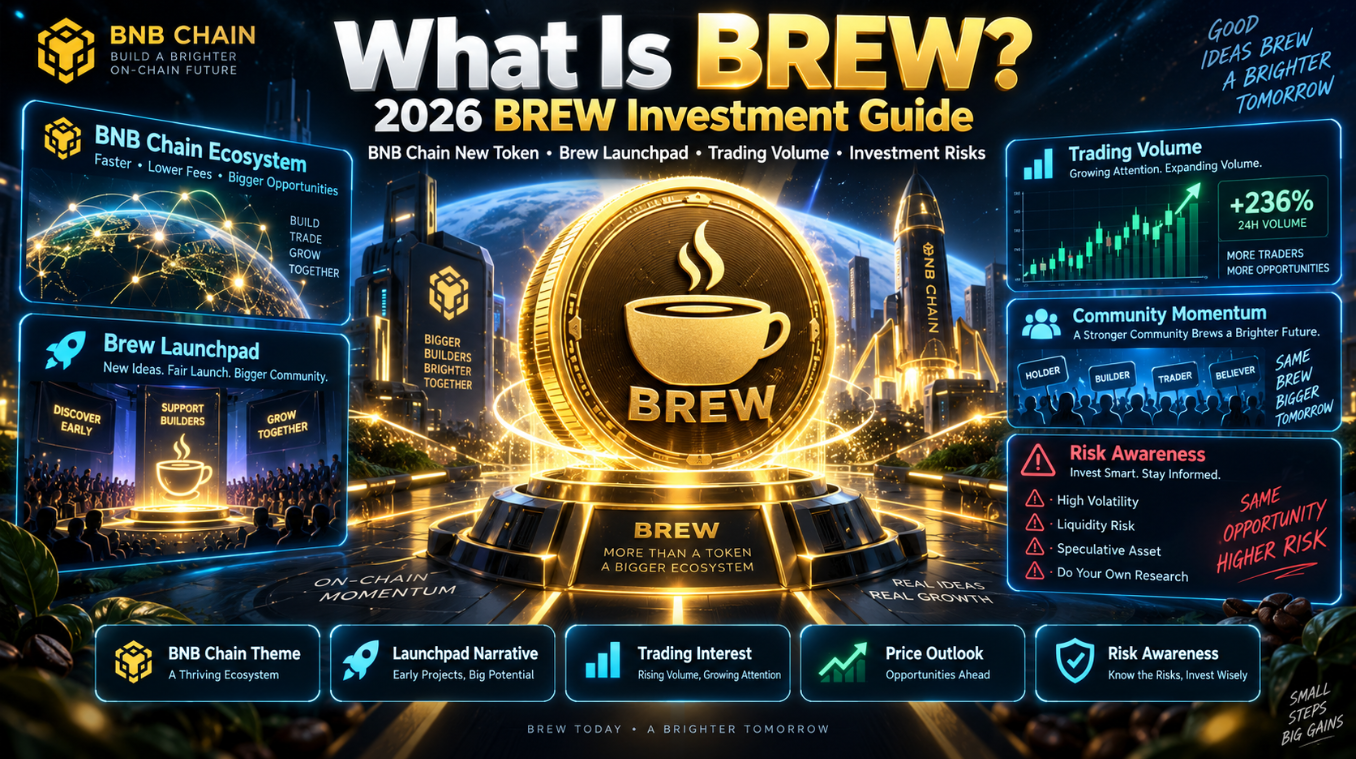
Why Can’t You Buy Just by Ticker?
After a new hype emerges, imitator tokens and fake websites proliferate quickly. The correct verification order is: BNB Smart Chain → full contract address → official portal → major trading pools → and only then logo and ticker.
If the contract is not 0xfa6D9B504848606Eb9aeC04CCc161D169B3f2159, even with the exact same name and icon, treat it as a different asset.
2. What Is the Brew Platform? How Is It Different from Typical Meme Launchpads?
Most meme launchpads follow a familiar flow: create a token, trade it on a bonding curve, reach a market cap or fundraising threshold, graduate, and then migrate liquidity to a DEX.
Brew takes a different route: once created, the token immediately establishes a trading pool on PancakeSwap V3, with the DEX handling price discovery from the start. PancakeSwap V3 uses concentrated liquidity — LP capital is deployed within specific price ranges, which can improve capital efficiency, but depth can also evaporate quickly once the price moves outside the active range.
Brew’s website describes the product as enabling creators to issue tokens using meme coins, other tokens, or stock-related on-chain assets as quote currencies. Its core differentiator is not just “you can launch tokens,” but giving creators the freedom to choose the trading pair.
For example, a new token could be designed as:
- CAT/BNB – using BNB as the main quote asset;
- CAT/USDT – reducing the impact of BNB price fluctuations;
- CAT/BREW – creating potential pairing demand for BREW;
- CAT/Another Meme – binding two community narratives together;
- CAT/Stock‑related Token – experimenting with a mashup of meme and RWA themes.
This means the Launchpad does not just create tokens; it also participates in deciding what asset the token is priced against, where liquidity comes from, and how community risks transmit across pairs.
3. What Problems Do “Any-Asset Pairing” and Double Pairs Solve?
The value of free pairing is that creators can choose a more suitable liquidity entry point based on their community’s holdings and narrative. If the community already holds large amounts of a certain meme or ecosystem token, they don’t have to convert everything into BNB or USDT to participate in the new market.
Double Pairs allow the same token to have two parallel markets — e.g., TOKEN/BNB and TOKEN/BREW. In theory, this increases entry points, lets users keep their BNB exposure, and introduces BREW ecosystem demand.
But “dual pools” are not all upside:
- Initial liquidity may be split across pools;
- Depth and effective price ranges may differ between the two;
- Arbitrage bots will move prices across pools;
- A crash in one quote asset can transmit to the other pool;
- Users might mistakenly take the price from a thin pool as the market-wide fair price.
Thus, more pairs do not necessarily mean better liquidity. To judge product effectiveness, look at total depth across pools, distribution of volume, spreads, and new user growth — not just the feature name “supports two pairs.”
4. How Does Brew Compete with Four.Meme, Flap, and Others?
Competition among BNB Chain Launchpads is not just about who can launch more tokens — it’s about who can consistently attract creators, traders, and liquidity.
Four.Meme follows the more familiar bonding-curve-to-graduation path; Brew highlights direct-to-PancakeSwap V3 and open pair selection; Flap and other new platforms are also experimenting with combinations of memes, RWA, and different liquidity assets.
For BREW investors, the truly important metrics are not which platform is loudest on social media, but:
- How many real creators are launching daily, consistently?
- How many new tokens still have active markets after 24 hours, 7 days?
- Is trading volume concentrated in the platform’s own token?
- Do creators and traders return for repeat usage?
- Are protocol fees actually accruing to the platform?
- Is Brew gaining sustainable market share?
If many launches occur but most tokens die quickly, surface growth does not equal product retention.
5. Why Did BREW Surge So Sharply at Launch?
BREW’s initial run can be broken down into five catalysts:
- New Launchpad narrative – BNB Chain users constantly seek projects that might replicate the network effects of top token-launch platforms.
- Free pair mechanism – Memes, BNB Chain tokens, and stock-related on-chain assets can all serve as quote assets, offering a story distinct from fixed BNB/USDT pairs.
- Meme + RWA theme overlap – As on-chain stock assets grow, “using stock tokens to provide liquidity for memes” becomes an easily spread new narrative.
- Fast CEX listings – Exchanges like LBank, MEXC, and KCEX can boost visibility, volume, and arbitrage efficiency — but listings are liquidity catalysts, not fundamental validation.
- Initial float and price discovery – New tokens lack long-term cost bases; short-term capital, bots, market makers, and FOMO can easily amplify moves.
So “rising over 1,000% in hours” proves at most that marginal buying was very strong in early thin liquidity — it does not prove that platform value increased tenfold.
6. Why Is BREW’s Volume So High? High Volume Is Not a Safety Signal
As of approximately 06:18 UTC on September 8, 2026, GeckoTerminal recorded the main BREW/WBNB pool price at ~0.00523, 24-hour volume of ~12.7 million, liquidity of ~426,000, ~37,600 trades in 24 hours, and an FDV of ~5.23 million.
During the same period, CoinMarketCap, using a broader market scope, showed a price of ~0.00548, market cap of ~5.47 million, and 24-hour volume of ~$19.51 million. The differences stem from varying trading venues, pairs, and snapshot times — do not mix numerators and denominators across sources.
Full-Market Turnover Ratio
Using CoinMarketCap’s consistent data:
24h Volume ÷ Market Cap = 19.51M ÷ 5.47M ≈ 3.56
This means nominal daily turnover is about 3.56 times market cap. That indicates extremely active churn, but it does not mean $19.51 million in net long-term inflows — trading volume double-counts the same capital being traded repeatedly.
Main Pool Liquidity Stress Ratio
Using GeckoTerminal’s main pool data:
Main Pool 24h Volume ÷ Main Pool Liquidity = 12.7M ÷ 0.426M ≈ 29.8
About 29.8x means the main pool saw nominal turnover far exceeding its capital base in one day. This generates significant fees, but it also signals high congestion — large entries or exits can cause substantial price impact.
What Do Different Volume-Price Combinations Mean?
- Price, Volume, and Liquidity all rising – improved participation and absorption;
- Price falling but Volume still high – possibly heavy churn, stop‑losses, or early distribution;
- Price rising but Volume and Liquidity declining – upside lacks fresh capital confirmation.
At this snapshot, BREW had already retraced over 80% from its ~$0.029 high. That demonstrates that high volume did not prevent a severe drop.
7. Is BREW’s Liquidity Really “Permanently Locked”?
Brew’s public statements say that the PancakeSwap V3 liquidity positions for launched tokens are held by the Brew Launcher Factory, and creators have no function to withdraw principal. If this operates as described, it can reduce the classic rug‑pull risk of creators directly draining LP principal.
However, publicly accessible pages at this time are insufficient to independently audit the Factory’s full source code, admin rights, upgrade permissions, emergency functions, or control over NFT Positions. Therefore, the proper phrasing is “the project claims permanent locking” — not “it has been proven that funds can never be withdrawn.”
Before trading, at minimum verify:
- Factory and Locker contract addresses;
- Whether contracts are open‑source and verified;
- What functions the Owner or multi‑sig can call;
- Whether proxies and upgrade rights exist;
- Who holds the PancakeSwap V3 Position NFTs;
- Whether principal and fees can be withdrawn separately;
- Whether any Emergency Withdraw path exists.
More importantly:
Locked Liquidity ≠ Locked Price.
Locking only addresses one type of withdrawal risk. It does not prevent a token from dropping 90% or 99%, nor does it solve concentrated holdings, contract bugs, illiquidity, or a crash in the quote asset.
8. How Is the 1% Trading Fee Allocated? What’s the Difference Between Burn and Buyback?
GeckoTerminal confirms the main BREW/WBNB pool uses a 1% fee tier. Brew’s public explanations state that Launch Pool trading fees need to be split between the token side and the quote asset side: token-side fees are used for burn, while quote-asset fees are distributed between the creator and the protocol according to set rules.
It is essential to distinguish two completely different mechanisms.
Trading Fee Burn
If a trade generates 1,000 Launch Token fees and those tokens are sent to a dead address or burned via contract logic, that is a token-side fee burn. The burn amount depends on trade direction, volume, pair, and fee collection method.
Protocol Revenue Buyback & Burn
If the platform first earns BNB or USDT revenue, then uses that revenue to buy BREW from the secondary market and burn it, that is a buyback-and-burn. This creates direct market buy pressure for BREW.
Currently, the public narrative that can be confirmed is mainly the former. There is insufficient official documentation to prove that Brew commits to using all or a fixed portion of protocol revenue for ongoing market buybacks of BREW. Therefore, one cannot write “Brew revenue is all used for buyback and burn.”
Even if early burn data shows tens of millions of tokens burned, continue to verify: are the burned tokens BREW itself or different Launch Tokens? Is the burn address irreversible? Which time period does the data cover? And was it caused by one‑off high volume?
9. Does BREW Have Any Fundamentals at All?
BREW is not yet a mature cash‑flow asset, but it cannot be analyzed purely as a meme coin either. A more reasonable approach is to observe whether Brew platform usage translates into token demand and supply changes.
The full value chain should be:
Creator Growth → More Launches → More Active Markets → Genuine Trading Growth → Fee Accrual → BREW Demand or Burn → Supply & Valuation Changes
Every step in this chain can break. For example: launches may grow but new tokens have no trading; platform volume may be high but driven mostly by bots or the BREW launch pool; the protocol may earn quote‑asset revenue but have no mechanism to pass that value to BREW holders.
Thus, platform success does not automatically equal token appreciation. You must prove that BREW is used as a common quote asset, as a fee‑burn target, or has some other clear value capture.
10. HIBT Launchpad 6‑Factor Framework
Factor 1: Launch Activity
Track daily and weekly new launches, number of creators, and repeat usage. One‑time bulk launches do not equal sustained demand.
Factor 2: Active Markets
Measure the proportion of launches that still have trading and valid liquidity after 24 hours, 7 days, and 30 days. Survival rates are more valuable than total launches.
Factor 3: Trading Volume
Distinguish BREW’s own volume, all Launch Token volume, bot churn, and genuine user trades. Also combine with Liquidity and Unique Traders.
Factor 4: Protocol Fees
Confirm total fees, creator share, protocol share, and withdrawable assets. Do not use aggregate DEX volume as a proxy for protocol revenue.
Factor 5: Token Burn
Examine burn targets, on‑chain transactions, cumulative amounts, and weekly changes. Only verifiable and sustained burns can affect long‑term supply.
Factor 6: Valuation
Compare BREW market cap with platform volume, protocol fees, and burn rate. If token valuation rises much faster than actual usage, price may have already priced in excessive growth.
Each factor can be rated Strong, Neutral, or Weak — this is more honest and easier to update than a single “9.8/10 buy” score.
11. BREW Price Scenarios: Bull, Base, and Bear
Bull Case: Brew Becomes a Mainstream BNB Chain Launchpad
This optimistic scenario requires sustained daily launches and creator growth, improving launch token survival rates, stable growth in unique traders and platform volume, verifiable protocol fees, ongoing BREW burns, real trading demand through Double Pairs, and more projects choosing TOKEN/BREW as a primary pool. If these conditions are met, BREW could transition from pure‑narrative trading to platform‑usage‑driven value. However, you must still assess whether current valuation already reflects that growth.
Base Case: Platform Survives, Initial Hype Normalizes
In a neutral scenario, launches and volume decline from the peak but retain a core group of creators and active markets; BREW continues as a small‑to‑mid Launchpad token, with price oscillating broadly alongside platform data and BNB Chain cycles. In this case, do not extrapolate first‑day volume to forecast the next year.
Bear Case: Narrative Stronger Than Real Usage
Bearish signals include: launches rapidly declining, most new tokens dying within days, creators and unique traders stalling, platform volume and fees persistently falling, burn rate slowing significantly, users unwilling to use BREW as a pair, Double Pairs only creating liquidity fragmentation, rivals like Four.Meme or Flap taking users, and contract permissions or team transparency issues emerging. If valuation remains high while these metrics deteriorate, the investment thesis needs reassessment.
12. How Should Beginners, Short‑Term Traders, and Long‑Term Investors Approach BREW?
Beginners: First Confirm Asset and Exit Capability
Verify BNB Smart Chain and the full contract address, check main pool liquidity, top‑10 holder addresses, and actual slippage. Do not assume “LP locked” means principal is safe, and do not use market cap as a substitute for exit depth.
Short‑Term Traders: Pre‑Define Three Conditions
- Entry Condition – e.g., volume re‑accelerates, liquidity increases, price breaks out with confirmation;
- Exit Condition – take‑profit, stop‑loss, volume decay, or large wallets moving to exchanges;
- Invalidation Condition – platform data or market structure disproves your original trading thesis.
Position size should be determined by maximum acceptable loss, not by target gain. For low‑liquidity assets, also leave room for slippage and the inability to exit promptly.
Long‑Term Investors: Build a Weekly Data Tracker
Follow the chain of “Launches → Active Markets → Volume → Fees → Burn → Valuation” — do not just watch price daily. Wait for multiple observation cycles to see if initial data is repeatable.
13. Why Do BNB, BTC, and ETH Still Matter?
BREW’s gas, DEX liquidity, Launchpad competition, and major capital flows all occur on BNB Chain, so BNB Real‑Time Price is an important environmental indicator. But the correct relationship is not “BNB goes up, BREW must go up.” Instead, observe BNB price, BNB Chain activity, meme capital flows, and Brew’s own user data simultaneously.
Investors may also consult BNB Price Prediction to gauge ecosystem risk appetite. If BNB rises while Brew’s launches, traders, and fees decline, BREW’s fundamentals are not improving.
BTC Price Prediction helps assess overall crypto liquidity, altcoin rotation, and risk‑off conditions. BREW is a high‑beta new asset and tends to be more fragile than established assets during market deleveraging.
Although BREW runs on BNB Chain, ETH Price Prediction can still serve as a comparative benchmark for EVM, DeFi, and RWA markets — but ETH moves do not directly generate Brew protocol revenue.
14. BREW’s Top 10 Risks
- New Token Risk – Extremely short trading and operational history; insufficient long‑term data.
- Valuation Risk – Token price may have run far ahead of platform user and revenue growth.
- Liquidity Risk – High volume does not mean large positions can exit with low slippage.
- High‑Turnover Risk – Extreme churn may come from bots, arbitrage, and short‑term capital loops.
- Platform Risk – BREW is highly dependent on Brew’s ability to keep attracting creators and traders.
- Competition Risk – BNB Chain Launchpad space is fiercely competitive; user switching costs are low.
- Smart Contract Risk – Factory, Locker, V3 Position, and fee logic all require thorough review.
- Team Risk – Public disclosure about core team and long‑term operational capabilities is limited.
- Tokenomics Misinterpretation Risk – Fee burns may be incorrectly marketed as protocol‑revenue buybacks.
- Market Risk – When BNB, BTC, or crypto overall turns risk‑off, new tokens may experience deeper drawdowns.
15. Final 12‑Point Checklist Before Buying BREW
- Network is BNB Smart Chain;
- Contract is
0xfa6D9B504848606Eb9aeC04CCc161D169B3f2159; - Current supply and verifiable burn amount;
- Market Cap and FDV;
- 24‑hour volume across all markets and its coverage scope;
- Main pool liquidity and large‑trade slippage;
- Volume / Market Cap ratio;
- Same‑pool Volume / Liquidity ratio;
- Holder count, top‑10 addresses, and address labels;
- Daily Launches, Active Markets, and Unique Traders;
- Platform Volume, Protocol Fees, and fee distribution;
- Factory, Locker, Owner, Proxy, and Withdraw permissions.
Among these, Daily Launches, Active Markets, Protocol Fees, and Burn Rate are far more useful for validating long‑term logic than “how much BREW gained today.”
16. FAQ: Most Common Questions About BREW
What coin is BREW?
BREW is the token associated with Brew, a Creator Token Launchpad on BNB Chain. It carries both new‑platform and meme narratives. Its long‑term value still depends on platform usage and token value capture.
What is the Brew platform?
Brew allows creators to issue new tokens and choose any on‑chain asset as the quote pair. New tokens go directly into PancakeSwap V3 pools.
Which chain does BREW run on?
BNB Smart Chain, using BNB for gas.
What is the correct BREW contract?
0xfa6D9B504848606Eb9aeC04CCc161D169B3f2159. Always re‑verify from multiple trusted sources before trading.
Is BREW a meme coin or a platform token?
It sits between the two: short‑term price is heavily driven by meme and Launchpad narratives, while it also tries to build platform‑token logic through pairs, fees, and burns.
Why did BREW suddenly pump?
Major catalysts include the new Launchpad narrative, free pairing, meme+RWA combo, CEX listing access, and early‑liquidity FOMO. This cannot be simply explained as “fundamentals maturing.”
Why doesn’t Brew use a bonding curve?
Its design emphasizes direct PancakeSwap V3 pools from launch, letting the DEX handle price discovery from the very beginning.
Is Brew’s liquidity really permanently locked?
The project states that principal liquidity for launched tokens is held by the Launcher Factory. Investors should still verify Factory source code, upgrade rights, and withdrawal permissions. Even if locked, it does not mean the price cannot go to zero.
Does BREW have a buyback‑and‑burn?
Current public information primarily supports token‑side fee burns. There is insufficient evidence to prove the protocol commits to using BNB or USDT revenue for ongoing market buybacks of BREW.
Does high volume mean BREW is safe?
No. High volume indicates active churn, but it can also mean congestion, distribution, and high slippage. Always analyze volume together with liquidity, market cap, and holder structure.
Is BREW suitable for long‑term holding?
You must first verify that Brew can consistently generate launches, active trading, protocol fees, and BREW demand or burns. First‑day gains and single‑day volume are insufficient for long‑term judgment.
What is BREW’s biggest risk?
The core risk is that platform data is not yet validated, while token valuation and trading activity have already moved rapidly. If launches, fees, and burns cannot be sustained, the narrative may cool off quickly.
17. Conclusion: What BREW Really Needs to Prove Is Whether Platform Growth Can Catch Up to Token Price
BREW’s most notable product innovation is Brew’s attempt to expand the BNB Chain Launchpad from “fixed BNB or stablecoin pairs” to a market‑creation tool where creators can choose multiple compatible assets as quote currencies. Direct‑to‑PancakeSwap V3, free pairing, and Double Pairs give it a three‑layer narrative: Launchpad, meme, and RWA/multi‑asset liquidity.
But product differentiation does not equal validated business model. The September 8, 2026, snapshot shows BREW’s full‑market 24‑hour volume was about 3.56 times its market cap, the main pool’s 24‑hour volume was about 29.8 times its liquidity, and the price had retraced over 80% from its short‑term high. These figures are more indicative of extreme price discovery and crowded short‑term trading than of reduced risk.
Long‑term judgment should continuously answer six questions: How many real launches does Brew have daily? How many markets survive? How many unique traders are there? What fees does the protocol actually earn? What exactly is being burned — and is it BREW? How much future growth is already priced in?
Only when the chain of “Launches → Active Markets → Volume → Fees → BREW Demand or Burn” can repeat consistently will BREW transition from a short‑term narrative asset to a verifiable platform‑token thesis. Until then, the first‑day surge proves market attention — not long‑term value.