
KOR Protocol is an onchain clearinghouse on Base designed to verify creative ownership, route licensable works to buyers, and settle payments automatically. KOR is its ecosystem token, not a share in the company or a claim on royalties. KOR/USDT listings were scheduled across several exchanges for November 4, 2026 at 14:00 UTC. The main risks are launch volatility, a 10-billion-token supply, future unlocks, and uncertain token value capture.
Key Takeaways
- KOR Protocol is trying to modernize the infrastructure behind creative rights, licensing, distribution, and payment—not merely attach NFTs to music.
- Its system is organized around three functions: Verify, Route, and Settle.
- The protocol reports five live applications: Korus, VRSNS, Pacer, Streamline, and KOR Hubs.
- KOR is issued on Base at
0xD3679306360705ba3580BC4130b56460FB4e6926. - Total supply is fixed at 10 billion KOR, with a reported initial circulating supply of approximately 2.2867 billion, or 22.87%.
- Team and investor allocations reportedly have no release at launch, followed by a 12-month cliff. That reduces immediate insider supply but creates a future unlock cycle.
- Product adoption does not automatically create demand for KOR. Investors must verify which token functions are live, mandatory, and economically meaningful.
- A launch listing confirms access to a market; it does not prove healthy liquidity, fair valuation, or sustainable demand.
- My view: KOR is a credible early-stage infrastructure thesis, but the token remains a high-risk investment until licensing activity, settlement volume, token usage, and post-launch liquidity can be independently measured.
1. What Is KOR Protocol?
KOR Protocol describes itself as a “creative asset clearinghouse.” In practical terms, it wants to give songs, video, film assets, stems, images, and other intellectual property a machine-readable record of ownership and permitted use. It then aims to connect those assets with buyers or applications and distribute payment according to predefined splits.
That matters because generative AI has made creative production faster while making rights management more complicated. A model can generate, remix, translate, or repurpose content at enormous scale, but commercial users still need answers to basic questions: Who owns the source material? Is AI training or remixing permitted? Which territories and channels are covered? How much does the license cost? Who receives the money?
Today, those answers are often scattered across contracts, spreadsheets, collection societies, label systems, publishers, distributors, and private databases. KOR’s thesis is that rights and commercial rules should become structured data that software can verify and transact against.
KOR is not simply an AI creator app
Some KOR products use AI, but the broader protocol is closer to transaction infrastructure. The project is attempting to connect four layers:
- A record of the asset and its provenance.
- Licensing conditions that define permitted use.
- Distribution or discovery systems that match the asset with demand.
- Payment rails that divide proceeds among rights holders.
This distinction is important for valuation. A consumer AI app may be judged by subscriber growth and retention. A clearing protocol should ultimately be judged by registered assets, completed licenses, settlement value, repeat commercial users, and the fees or token demand those activities generate.
What problem is KOR trying to solve?
KOR is addressing a coordination problem rather than claiming that blockchain creates copyright. Copyright and contractual rights still depend on applicable law and valid agreements. What blockchain can potentially improve is the shared record: who submitted an asset, what rights were attested, which license was executed, and how a payment was distributed.
The protocol’s value therefore depends on more than code. It needs credible rights holders, correct metadata, enforceable contracts, buyers willing to use the system, and reliable dispute handling. An immutable record is useful only if the data entering it is trustworthy.
2. How Does KOR Work? Verify, Route, and Settle
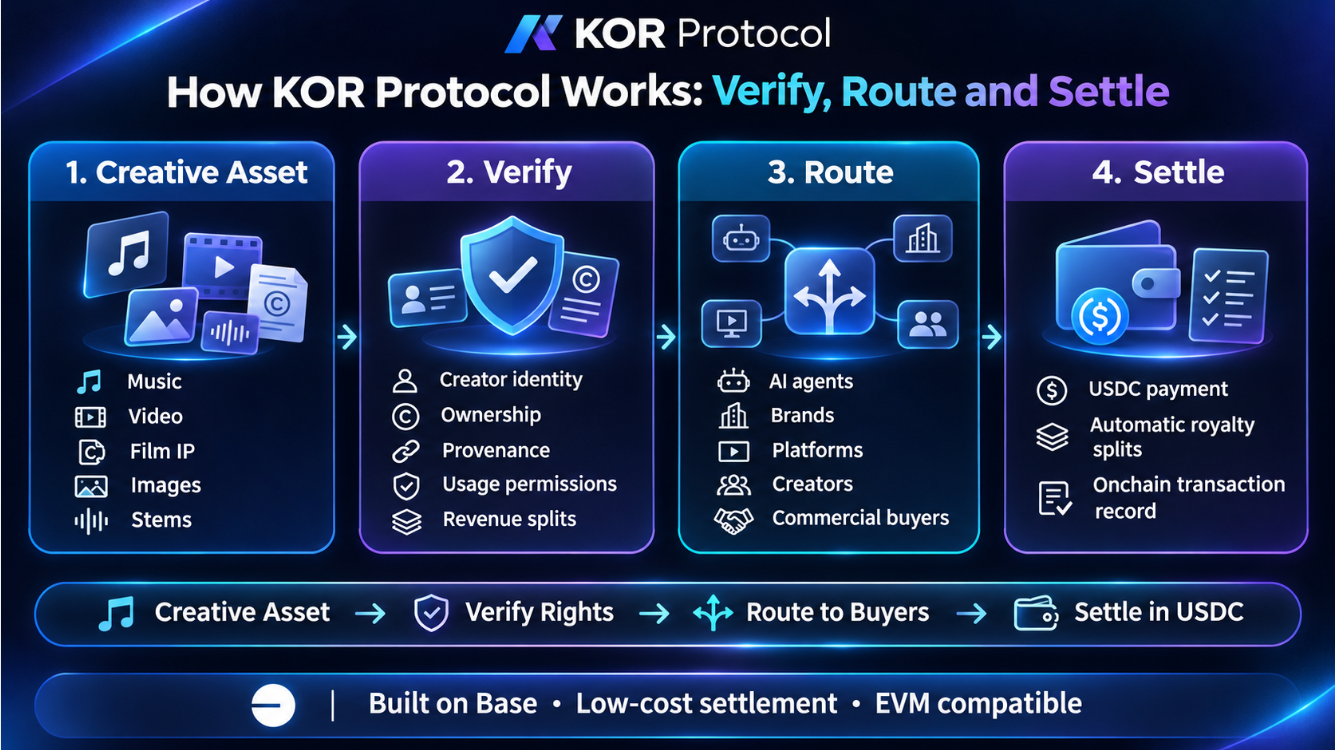
KOR organizes its infrastructure around three verbs. They form a useful framework for evaluating whether the project can move from narrative to measurable business activity.
Verify: establish provenance and commercial status
The Verify layer is intended to record authorship, ownership assertions, source material, clearance, and permitted uses. For a music asset, that could include the recording owner, composition rights, approved stems, remix permissions, revenue splits, and AI-use conditions.
Verification should not be confused with automatic legal certainty. If a user registers material they do not own, an onchain timestamp does not make the claim valid. The investment question is whether KOR’s controls are strong enough for professional rights holders to trust.
Route: match assets with buyers and opportunities
The Route layer is designed to connect cleared assets with platforms, brands, creators, distributors, or automated agents. A licensable sound could be surfaced to a remix application; an artist’s release could be matched with promotional channels; a catalog could be routed to a buyer seeking a specific style or territory.
AI agents may improve efficiency by searching rights data, comparing licensing conditions, and suggesting commercial opportunities. But investors should distinguish a working system from a future vision of autonomous licensing. The best evidence will be completed transactions and repeat buyers—not the number of AI features in marketing.
Settle: pay participants according to declared splits
The Settle layer aims to execute payment and allocate proceeds based on rules defined when the asset or license is registered. Stablecoin settlement, especially USDC on Base, can reduce cross-border friction and make small payments economically practical.
The strongest KOR thesis is straightforward: an asset is registered correctly, a buyer licenses it, payment settles immediately, and entitled parties receive their shares without months of reconciliation.
The weaker version is that onchain settlement remains a demo layer while most legal clearance, invoicing, and payments continue offchain. Investors should therefore monitor actual settlement volume and the percentage of activity that completes end to end.
Why Base?
KOR is deployed on Base, an Ethereum Layer 2 offering relatively low costs, EVM compatibility, and access to USDC. These properties suit frequent, low-value licensing and royalty transactions.
The official KOR contract is:
0xD3679306360705ba3580BC4130b56460FB4e6926
Always verify the complete address through an official project channel and a Base block explorer. Tickers are not unique, and other unrelated assets may also use “KOR.”
3. The KOR Product Ecosystem
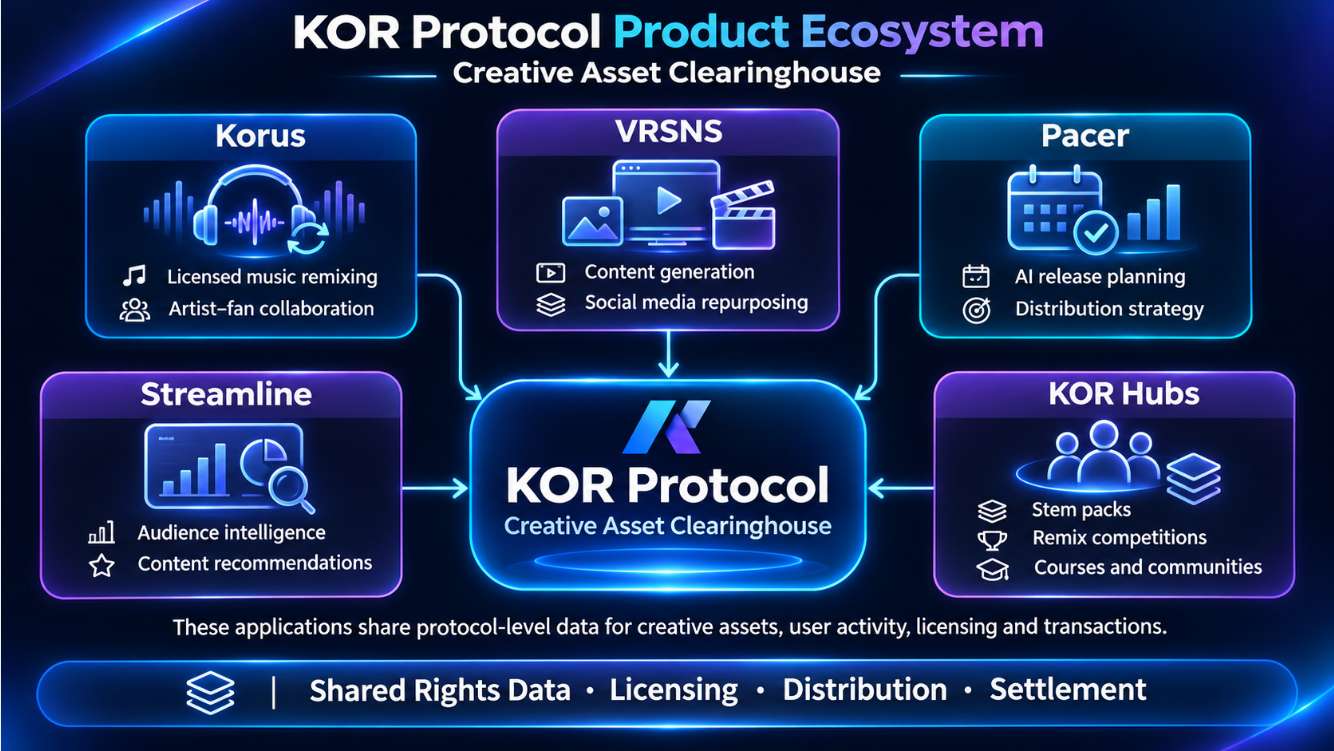
KOR’s strongest argument is that it is not launching a token around an empty white paper. The project reports five live applications, each approaching the creative economy from a different direction.
Korus
Korus is an interactive music and remix platform. Artists can make approved material available for creation, while fans can build derivatives under defined permissions. Its strategic value is not just user-generated music; it is the opportunity to test whether rights attribution and revenue splits can survive across a high-volume remix environment.
VRSNS
VRSNS focuses on content generation and repurposing for artists and fan communities. The relevant question is whether content output is tied to properly licensed inputs and whether usage generates measurable economic activity for rights holders.
Pacer
Pacer is positioned as an AI operating system for music careers. It assists with release planning, playlist pitching, content strategy, and distribution. Pacer could bring creators into the ecosystem even if they are not initially interested in blockchain. Its investment relevance depends on recurring use, paid services, and whether activity is routed through KOR’s shared rights and settlement infrastructure.
Streamline
Streamline turns performance data and content signals into recommendations. KOR says it can draw on a large body of trending-video data to help creators decide what to publish next. For investors, the key issue is defensibility: does the system develop proprietary intelligence through its network, or does it mainly repackage data that competitors can also access?
KOR Hubs
KOR Hubs lets artists and producers operate communities around stem packs, remix contests, courses, and paid feedback. This creates a direct path from intellectual property to creator revenue. It may also provide a natural testing ground for licenses, marketplace fees, and automated splits.
Are the adoption numbers meaningful?
KOR’s website reports more than one million lifetime sign-ups, roughly 285,000 NFTs minted, over 1,000 IP partners, and more than $2 million in gross revenue. It also names relationships or use cases involving organizations and properties such as Beatport, Black Mirror, mau5trap, Banijay Group, KDDI, and individual artists.
These figures are encouraging but should be treated as project-reported metrics unless independently audited. “Lifetime sign-ups” is not the same as monthly active users. “IP partners” can range from deep commercial integrations to limited campaigns. Gross revenue does not reveal net revenue, margin, recurring revenue, or how much accrues to the token economy.
For investment analysis, the better questions are:
- How many monthly active creators use the products?
- How many return after the first campaign?
- How many licenses and settlements complete each month?
- What is the value of those settlements?
- How much protocol revenue is generated?
- Which actions require KOR rather than fiat or stablecoins?
4. KOR Tokenomics and Value Capture
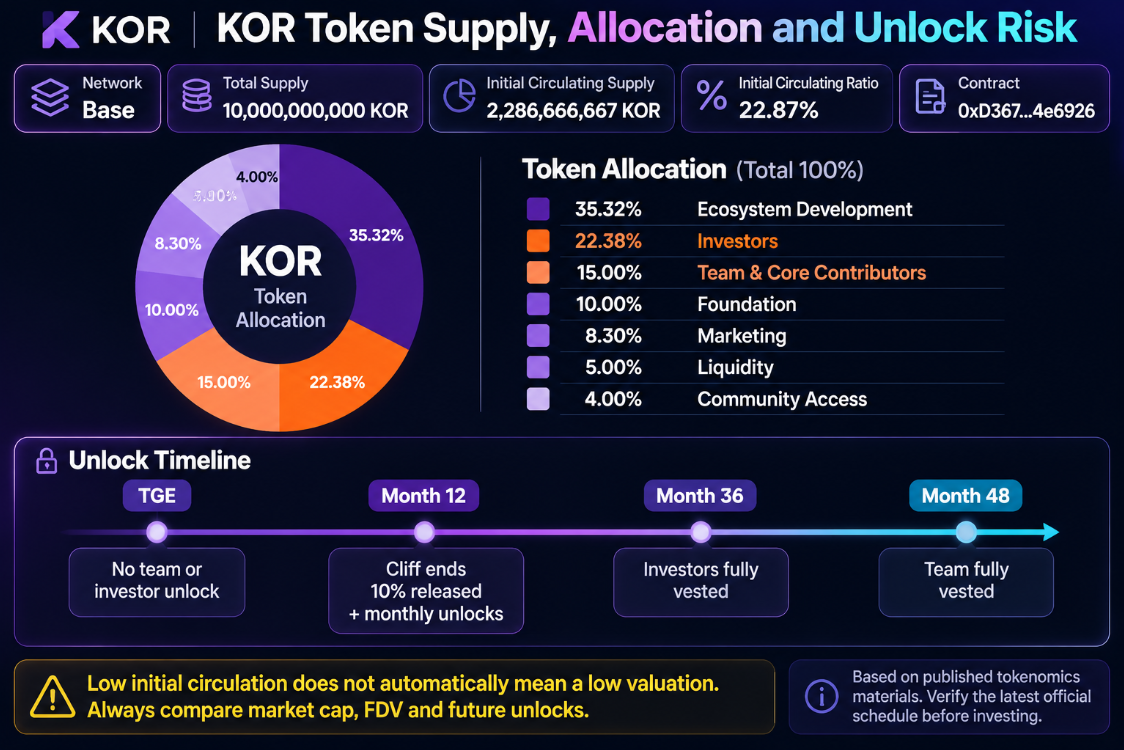
KOR has a fixed total supply of 10 billion tokens. Published tokenomics materials place the initial circulating supply at 2,286,666,667 KOR, approximately 22.87% of total supply.
The reported allocation is:
- 35.32% for ecosystem development, equal to 3.532 billion KOR.
- 22.38% for investors, equal to 2.238 billion KOR.
- 15% for the team and core contributors, equal to 1.5 billion KOR.
- 10% for the Foundation, equal to 1 billion KOR.
- 8.30% for marketing, equal to 830 million KOR.
- 5% for liquidity, equal to 500 million KOR.
- 4% for community access, equal to 400 million KOR.
The allocation creates two competing interpretations. On the positive side, ecosystem development is the largest category, giving the project resources to subsidize adoption. On the negative side, investors and the team collectively control 37.38% of supply. Their long-term alignment and eventual unlock behavior will matter greatly.
Vesting and unlock pressure
Published materials state that team and investor allocations do not unlock at the token generation event. Both categories have a 12-month cliff. At the end of the cliff, 10% of the relevant allocation is released, followed by monthly vesting. Investor tokens reportedly finish vesting by month 36, while team tokens finish by month 48.
That is more conservative than an immediate insider unlock, but it does not eliminate dilution. It postpones part of it. Investors should create an unlock calendar before treating a low circulating market capitalization as evidence that KOR is cheap.
Initial circulation also comes from categories that can produce sell pressure: ecosystem incentives, marketing, liquidity, Foundation operations, and community access. A token does not need insider unlocks to experience heavy supply during its first months.
What is KOR used for?
Public token materials describe four broad utilities:
- Access to premium intelligence or protocol services.
- Discounts on certain fees.
- Staking or collateral for participating partners, developers, or agents.
- Governance over protocol parameters as control decentralizes.
Each use must be assessed separately. A discount creates demand only if users already pay meaningful fees. Staking creates durable demand only if participation is valuable and penalties are credible. Governance has economic importance only when token holders control decisions that matter. Premium access helps only when the underlying data or service is worth paying for.
The central question is not “Does KOR have utility?” It is “How much KOR must real users acquire, hold, spend, or lock as protocol activity grows?” Until that relationship is measurable, product success and token appreciation remain separate hypotheses.
5. KOR Market Performance and Launch Conditions
KOR/USDT spot trading was announced for November 4, 2026 at 14:00 UTC on several exchanges. Bybit, Gate, MEXC, KuCoin, Bitget, and LBank published or surfaced listing information around the same launch window. Bybit confirmed deposits and withdrawals through Base and Mantle, while other venues may support different networks.
At the time this article was prepared, the scheduled opening had not yet produced a mature trading history. That means there was no reliable basis for quoting a stable “current price,” 24-hour volume, support level, or all-time high. Any pre-market indication or social-media target should not be presented as an established market price.
Launch incentives may also distort early data. Gate announced a 36 million KOR Launchpool, MEXC announced a 3,333,333 KOR promotional pool plus USDT rewards, and KuCoin promoted a HODLer airdrop. These campaigns can increase deposits, account activity, and short-term volume without proving organic investment demand.
What to measure after trading opens
Do not judge KOR from the first candle. Track:
- Spot volume rather than headline volume across leveraged products.
- Order-book depth within 1% and 2% of the mid-price.
- Bid-ask spread during both Asian and US trading hours.
- Deposit and withdrawal availability on the correct network.
- Price differences across exchanges.
- The concentration of trading on one venue.
- Changes in holder distribution and exchange balances.
A token can show hundreds of millions of dollars in reported volume and still have poor executable liquidity. The practical question is what happens when a real investor tries to buy or sell a defined amount.
6. Where to Buy KOR
KOR was scheduled to trade against USDT on multiple centralized exchanges. Availability depends on jurisdiction, account eligibility, and the exchange’s final operational status. Always verify the trading pair inside the official app or website after the published opening time.
How to buy KOR on Bybit
- Create or log in to an eligible Bybit account and complete any required identity checks.
- Deposit USDT using a network supported by Bybit. The deposit network for USDT does not need to be Base, but it must match the network used by the sending wallet or exchange.
- Search for the
KOR/USDTspot pair after trading is officially open. - Check the order book, spread, recent trades, and withdrawal status before placing an order.
- Use a limit order if launch volatility makes the market price uncertain. A market order prioritizes execution but may fill at several prices.
- Review the filled quantity, average price, and trading fee in order history.
- If withdrawing KOR, select a supported network and test with a small amount first. Confirm the receiving wallet supports the same representation of KOR.
Bybit’s announcement lists the Base contract above and says deposits and withdrawals are available through Base and Mantle. This is a critical operational detail: never assume a token deposited through one network can be withdrawn or received through another without an officially supported bridge.
Buying KOR on Gate, MEXC, KuCoin, Bitget, or LBank
The process is broadly similar: fund the account with USDT, locate KOR/USDT, review depth, and choose an order type. However, listing times, withdrawal times, supported networks, fees, and regional access can differ.
Promotional events should be assessed separately. Rewards may require holding another asset, verification, trading activity, or opportunity cost. Never increase position size merely to qualify for an airdrop.
Can KOR be bought on a DEX?
Because KOR is a Base token, a decentralized market may emerge on Base. Do not trade merely because a pool exists. Verify the contract, pool address, quote asset, liquidity, price impact, and whether the pool is recognized by official channels. A fake KOR pool can use the correct ticker and branding while pointing to a different contract.
For a DEX purchase, a user generally needs a Base-compatible wallet, ETH on Base for gas, and the correct quote token. Before signing, inspect the minimum received amount and token approvals. Revoke unnecessary approvals after use.
CEX or DEX—which is better?
A centralized exchange is usually simpler but introduces custody and withdrawal risk. A DEX gives direct wallet control, while contract verification, gas, slippage, and approvals become the user’s responsibility.
The better venue is available in your jurisdiction, supports the verified asset, and provides sufficient executable liquidity—not necessarily the largest reward.
7. KOR Price Prediction Without Fake Precision
It is too early to support a credible long-term target from price history. A more honest method is to translate possible fully diluted valuations into token prices and then test whether the business could justify them.
With a fixed supply of 10 billion KOR:
- A $50 million fully diluted valuation implies $0.005 per KOR.
- A $100 million fully diluted valuation implies $0.01 per KOR.
- A $200 million fully diluted valuation implies $0.02 per KOR.
- A $500 million fully diluted valuation implies $0.05 per KOR.
- A $1 billion fully diluted valuation implies $0.10 per KOR.
These are arithmetic scenarios, not predictions. At the reported initial circulation of roughly 2.2867 billion tokens, the corresponding initial circulating market capitalizations would be about 22.87% of those FDVs, assuming the circulation figure is accurate and the market price is uniform.
Bull case
The bullish scenario requires more than a strong AI narrative. KOR would need growing creative catalogs, repeat enterprise demand, verifiable licensing transactions, increasing USDC settlement, and token functions that create measurable holding or spending demand. A healthy market would also need sufficient spot liquidity and unlock absorption.
If KOR becomes a standard coordination layer for licensed AI content, music remixing, and creator payments, the market may assign it an infrastructure premium. But this scenario should be earned through operating data.
Base case
In the base case, the consumer products continue to operate and partnerships generate periodic activity, but onchain licensing grows slowly. KOR remains useful for access, incentives, and selected integrations, yet stablecoins or conventional payment methods handle much of the value transfer. The token may trade mainly around announcements, product launches, and broader crypto cycles.
Bear case
In the bearish scenario, product engagement does not convert into licensing volume or mandatory token demand. Incentive emissions and later unlocks increase circulating supply while organic buyers remain limited. Thin liquidity magnifies selling, and KOR trades as a short-lived AI/IP narrative rather than durable infrastructure.
Broader risk appetite also matters. Bitcoin price expectations can help frame the crypto market cycle, while Ethereum price expectations are relevant to Base and the wider EVM ecosystem. Neither forecast replaces KOR-specific analysis.
8. KOR Investment Strategy
My default approach would be to treat KOR as an early-stage venture-style token, not a core portfolio asset. The protocol is more substantial than a pure meme coin, but its value-capture mechanism has not yet been proven through public market data.
For short-term traders
Avoid trading the opening minute unless you understand auction mechanics, slippage, and thin books. Let deposits, withdrawals, and price discovery stabilize. Watch whether spot volume remains active after promotional rewards fade.
Define risk before entry. If the maximum acceptable portfolio loss is 0.5% and the trade invalidation level is 20% below entry, the position should be no more than 2.5% of the portfolio before fees and slippage. This is a risk-budget example, not a recommendation.
For medium-term investors
Use staged confirmation rather than one large purchase. An observation position can test market execution. A second allocation should require better evidence, such as growing product activity or transparent settlement data. A third should require stronger token value capture and reasonable valuation.
Do not average down simply because price is lower. Add only when the original thesis improves.
For long-term investors
Track a small set of decision-grade indicators:
- Monthly active creators and repeat usage across the five products.
- Number and value of completed licenses.
- USDC settlement volume and revenue splits.
- Protocol revenue and the portion connected to KOR.
- KOR spent, locked, or required for access.
- Token unlocks and exchange balances.
- Concentration among top non-contract holders.
- Enterprise partner retention, not merely announced partnerships.
A long-term position becomes more defensible only when usage, revenue, and token demand rise faster than circulating supply.
When I would reduce or abandon the thesis
I would lower my assessment if licensing activity remains opaque, token utility stays mostly planned, user growth depends on incentives, large allocations move to exchanges without explanation, or the project emphasizes sign-ups while avoiding active-use and revenue metrics.
The thesis also weakens if stablecoins handle all meaningful settlement while KOR is optional and economically unnecessary. A useful protocol can exist without a valuable token.
9. KOR Compared With Other Crypto Assets
KOR should not be grouped with every token using the words AI, creator, or protocol.
ANTFUN Token should be evaluated according to its own product and demand model; its market performance cannot validate KOR’s IP-clearing thesis. Forever Crypto represents another distinct narrative and should be analyzed through its actual utility, supply, and liquidity rather than superficial theme similarity. FLOAT Crypto likewise requires an asset-specific framework.
The useful comparison is methodological: What does the product do? Who pays? Why is the token necessary? How much supply will enter the market? Can investors exit without severe price impact?
KOR’s closest conceptual category is onchain intellectual-property and creator infrastructure. Its potential advantage is that it combines consumer applications, enterprise relationships, rights records, routing, and settlement. Its disadvantage is complexity. Every additional party—artists, labels, publishers, platforms, agents, and buyers—creates integration and legal risk.
10. Risks of Investing in KOR
Token value-capture risk
The protocol may gain users while KOR remains optional. If payments occur mainly in USDC and users can access services without holding meaningful KOR balances, token demand may lag product growth.
Unlock and dilution risk
Only about 22.87% of supply is expected to circulate initially. Future ecosystem distribution, Foundation use, marketing allocations, and the later release of investor and team tokens can create sustained supply. A low initial market cap can conceal a high FDV.
Launch liquidity risk
Multiple listings do not guarantee deep liquidity. Early books may be fragmented, spreads may widen, and withdrawals may not open simultaneously. Promotional volume can disappear quickly.
Intellectual-property and legal risk
Onchain records do not automatically resolve conflicting ownership claims. Licensing rules vary by jurisdiction, and AI-derived content raises unresolved questions about training rights, authorship, and derivative works.
Data-quality risk
Automated routing is only as reliable as the rights data. Incorrect metadata, fraudulent registrations, or outdated permissions could create disputes and damage enterprise trust.
Smart-contract and bridge risk
KOR depends on Base, smart contracts, wallets, and potentially cross-network infrastructure. Bugs, compromised keys, malicious approvals, or bridge failures could cause loss. A public audit or monitoring badge should never be treated as a guarantee.
Execution and competition risk
The project must persuade existing rights holders and distributors to change workflows. Major media companies already have established systems, while competing IP protocols, creator platforms, and conventional SaaS vendors may offer alternative solutions.
Governance and centralization risk
Early governance is likely to remain influenced by the Foundation, investors, and large allocations. Investors should verify how and when control transfers, which parameters token holders can change, and whether governance participation has substantive power.
11. Frequently Asked Questions
What is KOR Protocol?
KOR Protocol is an onchain clearinghouse on Base for registering creative rights, routing licensable assets to buyers or applications, and settling payments according to predefined splits.
What is the KOR token?
KOR is the protocol’s ecosystem token. Published uses include premium access, fee discounts, staking or collateral, incentives, and governance. Investors should verify which functions are live and mandatory.
What is the KOR contract address?
The announced Base contract is 0xD3679306360705ba3580BC4130b56460FB4e6926. Verify the full address before depositing, withdrawing, or using a DEX.
What is the total supply of KOR?
The fixed total supply is 10 billion KOR. Published materials report an initial circulating supply of approximately 2.2867 billion, or 22.87%.
Where can I buy KOR?
KOR/USDT listings were announced by exchanges including Bybit, Gate, MEXC, KuCoin, Bitget, and LBank. Confirm that trading is operational and available in your jurisdiction before funding an account.
Is KOR available on Base?
Yes. KOR is issued on Base. Some exchanges may also support deposits or withdrawals through another network representation, so always match the sending and receiving networks.
Is KOR a good investment?
KOR is a high-risk early-stage infrastructure token. It may deserve research because the protocol reports live products and commercial relationships, but long-term value requires proven licensing volume, settlement activity, token demand, and unlock absorption.
Can KOR reach $0.10?
At a 10-billion-token supply, $0.10 implies a $1 billion FDV. Whether that valuation is reasonable depends on adoption, revenue, token demand, liquidity, and future supply—not merely the arithmetic possibility.
Does KOR pay royalties to token holders?
KOR should not be assumed to represent equity, ownership of creative catalogs, or an automatic right to royalties. Any economic rights must be established by the applicable official terms.
What is KOR’s biggest risk?
The central risk is a gap between protocol adoption and token value capture. KOR Protocol could build useful products without creating enough required demand for KOR to offset emissions and unlocks.
Final Verdict: Is KOR Worth Buying?
KOR Protocol is more interesting than the average newly listed token because it targets a real problem: creative rights are fragmented, licensing is slow, and payment reconciliation is inefficient. The Verify–Route–Settle model is coherent, and the project reports live consumer products, recognizable partners, users, and revenue.
That does not make KOR automatically undervalued. The token launches with a 10-billion maximum supply, less than one quarter reportedly circulating, substantial ecosystem and insider allocations, and no mature public trading history. More importantly, many proposed utilities still need to prove that product activity creates compulsory, recurring KOR demand.
My conclusion is clear: KOR is worth monitoring as an early creative-IP infrastructure investment, but it is not yet a proven long-term value asset. I would not buy it solely because “AI and IP” are attractive narratives or because several exchanges listed it at once.
The evidence that would justify a higher conviction is equally clear: more verified licenses, more USDC settlement, transparent protocol revenue, measurable KOR usage, healthy spot liquidity, and demand strong enough to absorb future unlocks. Until those conditions appear, KOR belongs in the high-risk portion of a portfolio, if it belongs there at all.
Sources and Verification Notes
- KOR Protocol official website: project positioning, product suite, and project-reported adoption metrics.
- Bybit listing announcement: contract, listing schedule, and supported deposit/withdrawal networks.
- Gate listing and Launchpool announcement: KOR/USDT schedule and promotional reward terms.
- MEXC listing announcement: supply, project description, and launch promotion.
- KOR Protocol tokenomics summary and airdrop guide: allocation, initial circulation, and reported vesting schedule. Allocation and unlock details should be cross-checked against the latest KOR Foundation materials before publication.