
DGrid AI is a decentralized AI inference network that connects developers, model providers, and distributed computing nodes through a single gateway. DGAI is its utility token on BNB Chain and Arbitrum, used or planned for inference payments, staking, rewards, and governance. DGAI trades on HIBT and several other exchanges. Its main investment risks are quality verification, reliance on project-reported adoption, low circulating supply, future emissions, and a high fully diluted valuation.
Key Takeaways
- DGrid AI is infrastructure for accessing and verifying AI inference—not simply an AI chatbot or AI-agent token.
- Its AI Gateway offers a single, OpenAI-compatible endpoint for accessing more than 200 models from different providers.
- Proof of Quality, or PoQ, is designed to evaluate whether nodes deliver the model and service quality they promise.
- DGAI has a fixed maximum supply of one billion tokens across BNB Chain and Arbitrum.
- The latest official litepaper allocates 50% of supply to nodes, making network rewards the largest long-term source of new circulation.
- HIBT has announced DGAI/USDT spot trading using the BSC version of DGAI. Users should still check live depth, fees, and deposit or withdrawal status before trading.
- Product usefulness does not guarantee token appreciation. DGAI must capture demand from real inference payments, node collateral, and network participation.
- My view: DGrid AI has a more credible product thesis than a typical AI narrative token, but DGAI remains a high-risk investment until usage, revenue, node decentralization, and token demand are independently measurable.
1. What Is DGrid AI?
DGrid AI is a network for routing AI inference requests among multiple model and infrastructure providers. It aims to give developers one interface through which they can compare, call, pay for, and verify AI services instead of integrating separate APIs for every model vendor.
The project sits at the intersection of AI infrastructure and DePIN. It uses blockchain-based payments, staking, rewards, and records, while the actual inference computation takes place through participating service providers and nodes. It also includes user-facing products for model discovery, evaluation, and agent deployment.
Why does AI inference need an alternative infrastructure layer?
Centralized model access creates recurring problems: developers manage different APIs and billing systems, applications become dependent on one vendor, routing is difficult to verify, and high-performance inference remains expensive. A multi-provider marketplace may improve choice and utilization, although decentralization does not automatically make inference cheaper.
DGrid's answer is a common gateway with multiple suppliers, intelligent routing, onchain settlement, and a quality-verification layer. That makes it different from a project whose only product is a branded AI assistant.
DGrid AI project facts
- Project: DGrid AI
- Token: DGAI
- Category: Decentralized AI inference and AI DePIN
- Supported token networks: BNB Smart Chain and Arbitrum One
- BNB Chain contract:
0x10D4183389e99233db3cc981c43443Ebd28Ebd5e - Arbitrum contract:
0x12C2dE43878FB1A06C1Ead481f11E0C693a719c7 - Maximum supply: 1,000,000,000 DGAI
- Primary market pair: DGAI/USDT
- Core components: AI Gateway, model marketplace, distributed nodes, Proof of Quality, settlement contracts, and AI data availability
Because DGAI exists on more than one network, the ticker alone is not enough to identify the asset. Always match the complete contract and the network supported by the receiving exchange or wallet.
2. How Does DGrid AI Work?

DGrid's proposed transaction flow can be summarized as request, route, execute, verify, and settle. The technical ambition is substantial: users should be able to submit an inference request without manually selecting every provider, while the system chooses an appropriate service and produces evidence about its performance.
DGrid nodes and model providers
Nodes supply inference capacity or model access. Hardware requirements vary substantially by model size and service level.
DGrid documents several participant roles, including inference nodes, model providers, and validator nodes. The important distinction is economic:
- Inference nodes execute requests.
- Model providers make endpoints or models available and set commercial terms.
- Validators test or assess whether providers meet the network's quality requirements.
- Developers and applications generate demand by submitting calls.
Investors should ask for active-node counts, operator concentration, uptime, and the percentage of traffic served by independent nodes.
DGrid AI Gateway and routing
The AI Gateway provides a unified API. DGrid's marketplace currently advertises access to more than 200 models, OpenAI-compatible integration, multi-provider routing, and automatic failover. A developer can integrate one endpoint and then select among models for reasoning, coding, image understanding, or lower-cost tasks.
Routing may consider the requested model, price, latency, capacity, provider health, and previous quality performance. If one endpoint fails, another supplier serving the same model may take over.
The blockchain-specific question is whether PoQ, staking, and open participation improve reliability enough to justify additional coordination overhead.
What is Proof of Quality?
Proof of Quality is DGrid's main technical differentiator. The system describes a closed loop:
- A user submits a request.
- A node executes the inference.
- Validators or evaluation mechanisms score the response.
- Performance evidence is recorded so it can influence reputation, routing, and rewards.
The official marketplace describes three primary evaluation dimensions: accuracy compared with reference outputs, consistency across nodes, and compliance with the requested format. Cost and semantic similarity can also affect assessment.
This is easier for objective tasks than for open-ended writing or creative work, where different responses may both be valid. Investors should ask who creates reference answers, how subjective tasks are scored, whether validators can collude, and whether verification costs less than the request being protected.
PoQ should therefore be judged by real error-detection rates and economic outcomes, not only by its architecture diagram.
Payments, compute units, and settlement
DGrid's litepaper describes smart-contract billing that measures work in compute units and adjusts pricing according to task complexity and latency. A simplified model is:
Cost=Compute Units×Base Price×(1+Latency Adjustment)
The network also discusses x402-style pay-per-use authorization and an AI data-availability layer for records such as execution logs, fees, and quality scores.
Machine-to-machine payment is a compelling use case, but a payment design is not established payment volume. Investors should monitor real inference payments, provider payouts, and whether DGAI is required or optional.
How are malicious nodes discouraged?
DGrid links service participation with staking and penalties. Public materials describe possible slashing for poor performance or misconduct. The purpose is to make dishonesty economically costly.
Staking security depends on collateral exceeding the potential profit from cheating. Useful evidence includes validator decisions, appeals, and actual slashing events—not merely a penalty percentage in documentation.
3. DGrid AI Products and Real-World Use Cases
DGrid is more than a future node protocol. It currently presents several applications and interfaces that can be inspected. Still, product availability, usage, and token integration should be evaluated separately.
AI Gateway
The Gateway is the clearest product. Developers can use an OpenAI-compatible base URL to connect tools and applications to multiple model providers. DGrid has published integration guides for development tools, AI front ends, and agent frameworks.
Its advantage will depend on price, uptime, latency, model coverage, support, and whether verification adds value.
Model Marketplace
The marketplace allows providers to list model endpoints, define pricing, and receive onchain settlement. Developers can compare models and route demand through one interface.
Headline model counts matter less than active models, paid calls, repeat developers, and provider earnings.
AI Arena
AI Arena lets users or automated agents compare model responses. Human preference data can help identify which models perform best for particular tasks, while Arena for Agent extends evaluation through automated evaluators.
Evaluation data could improve task-specific routing. The risk is incentive distortion: participants may farm rewards, while automated judges may inherit model biases.
DClaw
DClaw is positioned as a one-click deployment layer for personal AI agents. It combines model access, memory, skills, and communication channels so that users do not need to build the entire infrastructure themselves.
DClaw matters only if it sends sustained paid inference traffic through DGrid and creates DGAI demand.
Validator network and staking
DGrid announced that validator nodes and DGAI staking went live in August 2026. Validators are intended to provide economic security for PoQ. This is more meaningful than a purely promotional staking pool if the validators perform measurable work.
Investors should verify active validators, delegated stake, concentration, exit delays, rewards, and penalties. Promotional APYs are not guaranteed returns.
Does DGrid have real users and revenue?
DGrid has publicized significant adoption and revenue figures, including paying users, Arena participation, and multi-million-dollar revenue. These figures are useful leads, but they should be labeled project-reported and not independently audited unless financial statements or an independent assurance report become available.
Company cash inflow is not necessarily protocol revenue, and protocol revenue is not necessarily value accruing to DGAI.
For stronger evidence, investors should look for:
- Monthly paid API calls.
- Paying-user retention.
- Revenue separated by subscriptions, inference, node services, and token-related sales.
- Provider payouts.
- Inference volume settled onchain.
- DGAI spent or locked for productive use.
4. DGAI Tokenomics: Supply, Distribution, and Utility
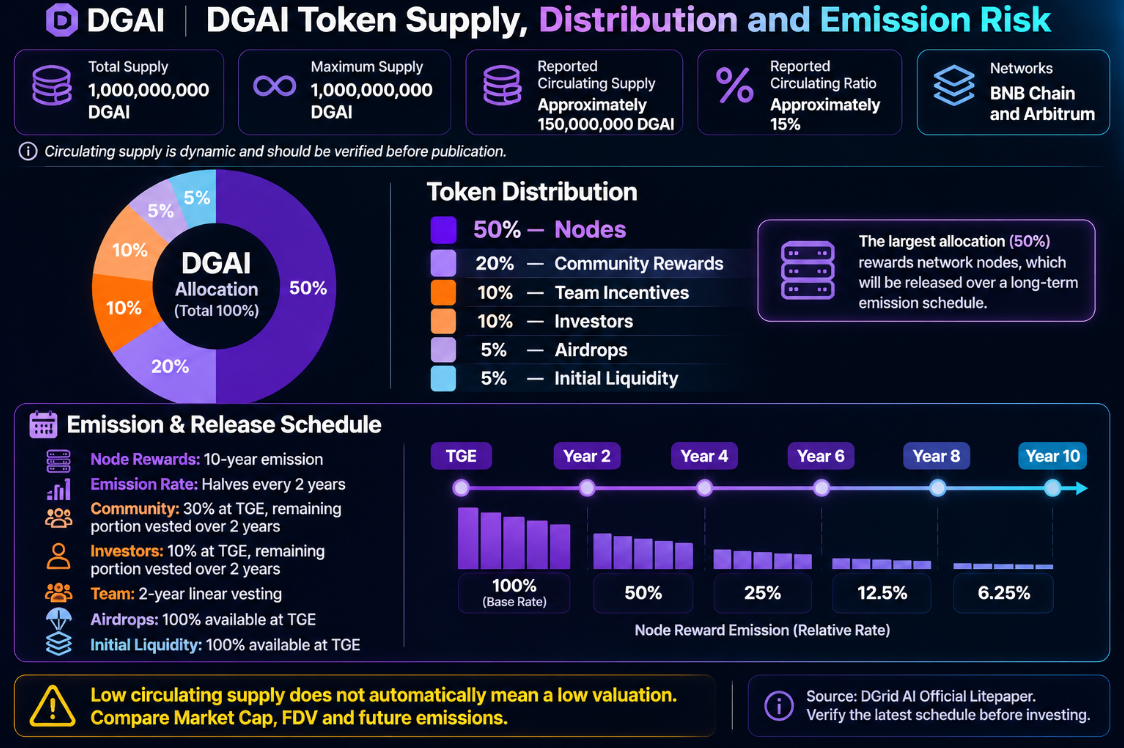
DGAI has a fixed maximum supply of one billion tokens. There is no planned inflationary minting beyond that cap; node rewards are distributed from tokens allocated at launch.
Latest official distribution
The current official litepaper allocates the supply as follows:
- 50% to nodes: 500 million DGAI for inference execution and network security.
- 20% to community rewards: 200 million DGAI for grants, cooperation, integrations, and community programs.
- 10% to team incentives: 100 million DGAI.
- 10% to investors: 100 million DGAI.
- 5% to airdrops: 50 million DGAI.
- 5% to initial liquidity and market stability: 50 million DGAI.
This matters because some older or third-party pages show a different allocation of 15% community, 8% airdrops, and 7% liquidity. Those figures should not be mixed with the current official litepaper.
Unlock and emission schedule
The largest allocation—node rewards—is designed to release over ten years, with the emission rate halving every two years. That supports long-term participation but creates continuing supply that node operators may sell to cover hardware, cloud, electricity, and staff costs.
The official litepaper says community rewards unlock 30% at the token generation event, with the remainder vesting linearly over two years. Investor tokens have a 10% initial unlock, followed by two-year linear vesting. Team incentives vest linearly over two years. Airdrops and initial liquidity are fully available at launch.
Unlocked, circulating, and sold supply are different. Nevertheless, unlocks increase the amount that can potentially enter the market.
What is DGAI used for?
The intended utilities are:
- Paying for AI inference, agent services, and related network functions.
- Staking by validators, nodes, and service providers.
- Rewarding inference providers, validators, developers, and ecosystem contributors.
- Participating in governance over fees, supported models, upgrades, and ecosystem funding.
The loop supports DGAI only if the token is economically important. If users pay with stablecoins while providers sell rewards, network activity may not produce sustained token demand.
Staking is not free yield
DGrid has promoted validator staking with long exit periods and high token-denominated APYs. Examine the live terms:
- Is the yield funded by network fees or new token emissions?
- How long is the unstaking delay?
- Can delegated tokens be slashed?
- Can the reward rate change?
- How concentrated is validator power?
- Does reward value exceed dilution and token-price risk?
Staking can reduce liquid supply temporarily while distributing tokens that may later be sold.
5. DGAI Price, Volume, and Liquidity
DGAI began spot trading in August 2026. KuCoin's official announcement opened DGAI/USDT trading on August 24 and supported BSC-BEP20 deposits. The token later appeared on Bitget, Gate, MEXC, Kraken, Toobit, HIBT, and other venues, as well as PancakeSwap pools on BNB Chain and Arbitrum.
On November 5, 2026, market snapshots showed DGAI around 0.70–0.79 depending on timing and source. This is why readers should use live data rather than a frozen article price.
Readers can check the DGAI live price and market page for the latest displayed price, chart, and market information. Final execution prices depend on the order book at the time an order is placed.
The low-float, high-FDV issue
Third-party aggregators have reported approximately 150 million DGAI circulating, equal to 15% of the one-billion maximum supply. If that figure is accurate, the fully diluted valuation is about 6.67 times the circulating market capitalization at the same token price.
That does not prove DGAI is overvalued. It does mean the market must eventually absorb a much larger potential supply. Investors should not call the token "cheap" because the circulating market cap looks smaller than that of established AI projects.
How to evaluate liquidity
Headline volume alone is insufficient. Check:
- Bid-ask spread on the intended exchange.
- Buy and sell depth within 1% and 2% of the current price.
- Price differences between CEXs and DEXs.
- The share of volume coming from one venue.
- DEX pool liquidity and estimated price impact.
- Perpetual volume, open interest, and funding compared with spot volume.
High leveraged volume may represent short-term speculation rather than long-term spot demand. A real liquidity test asks how much price moves when a user tries to buy or sell a specific amount.
6. Where to Buy DGAI
DGAI can be purchased through HIBT and other centralized exchanges that support DGAI/USDT, or through verified PancakeSwap pools on BNB Chain or Arbitrum. Availability, fees, networks, and regional restrictions vary.
How to buy DGAI on HIBT
HIBT has published a DGAI listing announcement for the DGAI/USDT spot pair and identifies the supported currency type as BSC. This allows the purchase section to use HIBT as a real trading route rather than a hypothetical example.
Step 1: Create and secure a HIBT account
Open the official HIBT website or app, register an account, and complete any identity verification required for your region. Enable two-factor authentication and anti-phishing protections before depositing funds.
Step 2: Deposit or acquire USDT
DGAI is quoted against USDT. Deposit USDT into HIBT using a network supported on the deposit page. The network selected by the sender must exactly match HIBT's receiving network. A USDT deposit network is separate from the network later used to withdraw DGAI.
Step 3: Open the DGAI/USDT market
Use the HIBT DGAI/USDT trading page or search for DGAI in Spot Trading. Confirm that the pair is DGAI/USDT, not a similarly named token or a leveraged derivative.
Before ordering, inspect:
- Latest price.
- 24-hour volume and volatility.
- Best bid and ask.
- Order-book depth.
- Trading fee.
- Deposit and withdrawal status.
Step 4: Choose a limit or market order
A limit order lets the buyer define the maximum price and can reduce entry-price uncertainty. It may not fill if the market moves away.
A market order executes against available sell orders. It is faster but can create slippage, especially when the order book is thin. New users should review the estimated cost and received amount before confirming.
Step 5: Review the filled order
After execution, check the average price, DGAI quantity, fee, and remaining USDT. Record the cost basis if the position will be held for investment analysis.
Step 6: Withdraw only through a supported network
HIBT's listing information identifies DGAI as BSC. If withdrawing, confirm the current withdrawal page still supports BNB Smart Chain and that the destination wallet is configured for the BSC contract:
0x10D4183389e99233db3cc981c43443Ebd28Ebd5e
Use a small test withdrawal for a significant transfer. Do not send the Arbitrum version to a BSC-only deposit address unless the platform explicitly supports cross-chain deposits.
Other centralized exchanges
DGAI/USDT has also been listed by KuCoin, Bitget, Gate, MEXC, Toobit, and other platforms. Kraken has displayed a DGAI/USD market. Compare executable depth, fees, withdrawal networks, and account eligibility—not just the exchange name.
Binance Alpha exposure or a Binance Wallet campaign should not be described as a Binance main-exchange spot listing. These are different products with different access and liquidity.
How to buy DGAI on PancakeSwap
- Install a compatible self-custody wallet.
- Select BNB Smart Chain or Arbitrum.
- Hold the network's native gas asset.
- Open the official PancakeSwap interface.
- Import the correct DGAI contract for the selected network.
- Confirm the pool, quote token, liquidity, and price impact.
- Review the minimum received amount and approval request.
- Submit the swap and verify it in the appropriate block explorer.
DEX trading gives the user custody but introduces contract, phishing, approval, bridge, and slippage risks. New users will usually find a reputable CEX spot market simpler.
7. DGAI Price Prediction: Bull, Base, and Bear Cases
Long-term targets based only on a short price history are unreliable. A better framework combines valuation arithmetic with conditions that would justify each valuation.
With one billion maximum tokens:
- A $100 million FDV equals $0.10 per DGAI.
- A $250 million FDV equals $0.25.
- A $500 million FDV equals $0.50.
- A $750 million FDV equals $0.75.
- A $1 billion FDV equals $1.00.
- A $2 billion FDV equals $2.00.
These are mathematical scenarios, not forecasts.
Bull case
The bull case requires sustained paid API calls, growing independent nodes, expanding model supply, reliable PoQ results, and increasing DGAI payment or staking demand. Network fees would need to demonstrate that economic activity is more than promotional incentives.
Base case
DGrid's gateway and products continue operating, but most demand is for familiar centralized models routed through an aggregator. Token use grows more slowly than product usage, while node and community emissions increase supply. DGAI trades around product announcements and the broader AI narrative.
Bear case
Developer adoption stalls, decentralized nodes remain concentrated, PoQ cannot economically verify complex responses, and lower-priced centralized gateways compress margins. Token emissions and unlocks outpace productive demand, leading to valuation compression.
The DGAI price prediction page can provide an additional market-expectation reference, but it should not replace fundamental analysis. Broader risk appetite can be monitored through Bitcoin price scenarios and Ethereum price scenarios. Neither asset directly determines DGrid's business performance.
8. DGAI Investment Strategy
My default classification is a high-risk early-stage infrastructure token. DGrid has inspectable products and a plausible business problem, but token value capture, network decentralization, and reported financial performance need stronger independent evidence.
Short-term approach
Short-term traders should monitor spot volume, order-book depth, funding rates, open interest, exchange inflows, and large-wallet movements. Do not treat an exchange campaign or AI-sector rally as proof of fundamental improvement.
Avoid excessive leverage. Low-float tokens can move sharply in both directions, and a liquidation can occur before a long-term thesis has time to develop.
Medium-term approach
Over one to three months, track API calls, model-provider growth, active validators, delegated stake, inference payment volume, and circulating-supply changes. Use staged entries only when evidence improves rather than averaging down automatically.
Long-term approach
A long-term position should require answers to six questions:
- Are developers repeatedly paying for the Gateway?
- Is traffic served by diverse, independent providers?
- Does PoQ detect real service failures at reasonable cost?
- Are network fees and provider payouts transparent?
- Does activity require users or nodes to acquire and hold DGAI?
- Can demand absorb the ten-year node emission schedule and other vesting?
If the answers remain unavailable, the position is speculation on future adoption rather than an investment supported by established cash flow.
Position sizing example
Suppose a portfolio is $1,000 and the maximum acceptable loss on one trade is $20. If the invalidation point is 10% below entry:
Position Size=10%/$20=$200
The real position should be smaller after accounting for fees, slippage, and the possibility that a stop order fills below its trigger. This example illustrates risk budgeting; it is not a recommendation to allocate 20% to DGAI.
Signals that would invalidate the thesis
- Gateway usage declines after rewards end.
- Project-reported revenue cannot be reconciled with paid inference activity.
- Most traffic depends on a small group of related providers.
- Token payments remain optional and economically insignificant.
- Validator concentration or unexplained governance power remains high.
- Emissions and unlocks grow faster than demand and liquidity.
- Security incidents affect contracts, bridges, staking, or user funds.
9. DGAI Compared With Other Crypto Projects
DGAI should be compared with AI inference networks and model marketplaces, not every token containing "AI" in its name. Useful comparison criteria include paid inference volume, active providers, independent nodes, latency, verified failures, developer retention, token necessity, and circulating-supply growth.
Traditional AI gateways can also aggregate models and offer failover. DGrid's differentiators must therefore come from open provider participation, verifiable service quality, machine payments, and economic accountability. If these features do not improve price, reliability, or trust, blockchain adds complexity rather than value.
DGAI also differs fundamentally from FLOAT Crypto. DGAI's thesis depends on AI inference, nodes, model providers, and PoQ. FLOAT's thesis depends on its own asset-launch and trading mechanisms. Comparing their percentage returns would reveal little about which business model is stronger.
10. Risks of Investing in DGAI
AI output and PoQ risk
AI answers can be subjective. Reference-based scoring may reward similarity rather than truth, while automated judges may introduce bias. An inadequate PoQ system could create false confidence.
Node decentralization risk
The network may appear decentralized while relying on a few cloud providers or official APIs. Hardware claims, uptime, ownership, and traffic distribution need verification.
Business-model risk
Centralized AI providers may reduce prices or improve multi-model access. Developers may prefer conventional billing, support, and service agreements. DGrid must compete on more than token incentives.
Tokenomics risk
Only a fraction of the one-billion supply is reported as circulating. Node rewards, community programs, team incentives, investor vesting, and airdrops can increase liquid supply. High staking rewards may also be inflation transferred to stakers rather than real yield.
Liquidity and market risk
Market depth can disappear during stress. Volume may be concentrated on a few venues or driven by derivatives. A price displayed on a chart does not guarantee that a large holder can exit near that price.
Smart-contract, bridge, and admin risk
DGAI exists across BNB Chain and Arbitrum. Token, staking, billing, and cross-chain systems may contain bugs or privileged roles. Verify audits, upgrade permissions, and incident history.
Data-transparency risk
User, revenue, model, and API-call figures may come from project-controlled sources. Even genuine metrics can be defined in flattering ways. "Calls today" may include free or internal traffic; "paying users" may include low-value or one-time purchases.
Regulatory risk
AI services, token rewards, staking, privacy, and cross-border payments face changing rules. Availability and product features may differ by jurisdiction.
11. Frequently Asked Questions About DGAI
What is DGrid AI?
DGrid AI is a decentralized AI inference network offering a unified model gateway, distributed providers, quality verification, marketplace functions, and blockchain-based settlement.
What is the DGAI token?
DGAI is the network's utility token for intended uses including inference payments, staking, provider and community rewards, and governance.
Which blockchains support DGAI?
DGAI is issued on BNB Smart Chain and Arbitrum One. Always use the contract corresponding to the selected network.
What are the DGAI contract addresses?
The BNB Chain contract is 0x10D4183389e99233db3cc981c43443Ebd28Ebd5e. The Arbitrum contract is 0x12C2dE43878FB1A06C1Ead481f11E0C693a719c7.
Where can I buy DGAI?
DGAI is available through HIBT and other announced markets including KuCoin, Bitget, Gate, MEXC, Kraken, and PancakeSwap. Check regional access and live market status.
How do I buy DGAI with USDT on HIBT?
Fund an eligible HIBT account with USDT, open DGAI/USDT, inspect the order book, and place a limit or market order. HIBT identifies DGAI as a BSC asset for its listing, so verify the network before withdrawing.
What is the total supply of DGAI?
The maximum and total supply are fixed at one billion DGAI. Circulating supply is lower and changes as allocated tokens enter circulation.
What is DGAI used for?
Its intended uses are AI-service payments, node or validator staking, ecosystem rewards, and protocol governance. Actual value depends on adoption and whether these functions create net demand.
Is DGAI a good investment?
DGAI is a high-risk AI-infrastructure investment. It has a clearer product thesis than a pure narrative token, but adoption, revenue, decentralization, value capture, emissions, and valuation need continued verification.
Can DGAI reach $1?
At one billion maximum tokens, $1 implies a $1 billion FDV. Reaching that price is mathematically possible but requires the market to justify the valuation through adoption, demand, liquidity, and expectations.
Final Verdict: Is DGAI Worth Buying?
DGrid AI is attempting to solve a genuine infrastructure problem. Developers need easier access to multiple models, better routing, dependable failover, and credible ways to evaluate service quality. The AI Gateway, marketplace, Arena, DClaw, and validator network give the project more substance than a token built only around an AI slogan.
The hardest part remains unproven: turning product activity into durable DGAI demand. A gateway can be useful while payments occur in stablecoins, providers sell rewards, and token emissions expand supply. Project-reported user and revenue figures are encouraging but should not be treated as audited proof of long-term economics.
My conclusion is that DGAI deserves continued research but not automatic long-term conviction. It is suitable only for investors who understand early-stage infrastructure, token emissions, staking risk, and volatile liquidity. I would raise my assessment only if DGrid publishes verifiable paid inference volume, diverse node participation, meaningful PoQ results, transparent provider payouts, and evidence that productive demand is absorbing new supply.
The correct order is: verify the product, verify the network, verify the token's value capture, and only then decide whether the market price is attractive.
Sources and Verification Notes
- DGrid AI official website and model marketplace: product positioning, model access, routing, and PoQ descriptions.
- DGrid AI official litepaper: supply, token distribution, vesting, payment, and node-reward design.
- DGrid AI documentation repository: token contracts, product documentation, and integration materials.
- DGrid AI official blog: product launches, validator staking, marketplace, x402, and integration announcements.
- DGrid AI MiCA-format white paper: issuer disclosures, planned functions, risks, and roadmap context.
- KuCoin listing announcement: August 2026 listing date, DGAI/USDT pair, and BSC deposit support.
- CoinGecko DGAI markets: third-party market venues, prices, volume, and depth snapshots.
- HIBT DGAI/USDT trading page: HIBT spot market used in the purchase walkthrough.
This article is for education and research, not financial advice. Token supply, product features, exchange support, prices, and regulations can change. Recheck official sources before acting.