
Editorial note: This article is for information and education only, not financial advice. Crypto assets can lose most or all of their value. Market data cited below was checked on November 10, 2026 and may change quickly.
Kinetiq is a liquid-staking and financial-infrastructure protocol in the Hyperliquid ecosystem. Its KNTQ token is used for governance, staking into sKNTQ and ecosystem benefits. Kinetiq earns revenue from liquid staking, validator commissions, Markets, Launch and Elysium; defined shares fund open-market KNTQ buybacks. Under the current KIP-5 model, purchased tokens go to Hyperliquid’s Assistance Fund. KNTQ trades on Hyperliquid, Kraken, MEXC and LBank, while HiBT has announced KNTQ/USDT.
Key Takeaways
- Kinetiq began with HYPE liquid staking but now spans kHYPE, Markets.xyz, Launch and the Elysium network.
- KNTQ is the governance and value-accrual token; it is not kHYPE and it is not Elysium’s gas token.
- Current Mechanism: protocol-funded KNTQ buybacks are sent to the Hyperliquid Assistance Fund under KIP-5, rather than distributed to sKNTQ stakers.
- Kinetiq has a real revenue-to-token pathway, but buybacks depend on actual protocol activity and can be outweighed by unlocks or selling pressure.
- KNTQ has a fixed maximum supply of 1 billion, while only about one-third was reported as circulating at the review date.
- Core-contributor and investor unlocks are a major near-term risk after the one-year cliff.
- KNTQ is available on several confirmed markets. HiBT announced KNTQ/USDT on November 10, 2026; users should confirm that trading and withdrawals are live before funding an account specifically to buy it.
- My assessment: KNTQ is a credible but high-risk Hyperliquid infrastructure bet—better suited to a monitored satellite position than a core holding.
1. What Is Kinetiq?
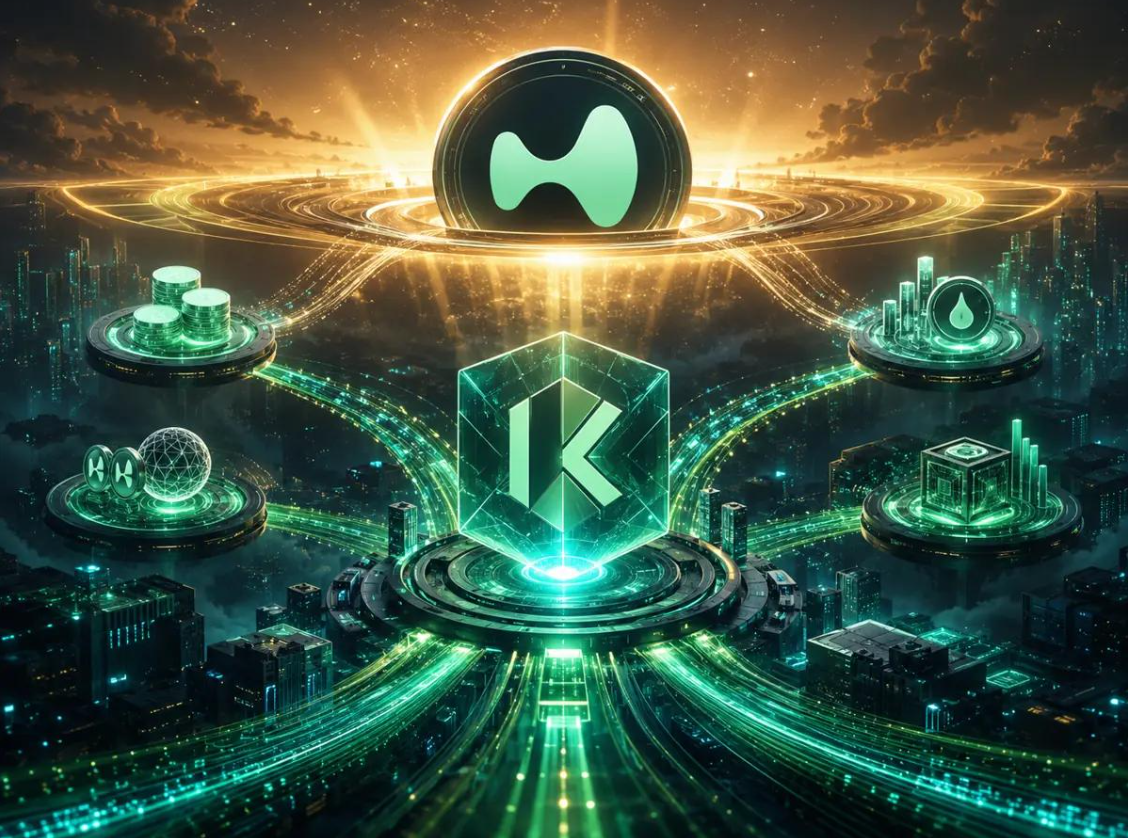
Kinetiq is a liquid-staking and financial-infrastructure protocol built for the Hyperliquid ecosystem. Its original flagship product, kHYPE, lets users stake HYPE while retaining a liquid token that can be transferred or used in DeFi. Kinetiq has since expanded into validator coordination, on-chain markets, market deployment and an execution network called Elysium.
The four names beginners must separate are:
- HYPE: the native asset of Hyperliquid.
- kHYPE: a liquid-staking receipt representing staked HYPE plus accrued rewards, subject to the protocol’s mechanics and risks.
- KNTQ: Kinetiq’s governance and value-accrual token.
- sKNTQ: the staked representation of KNTQ, used for governance and tiered ecosystem benefits.
This distinction matters. Buying KNTQ does not mean staking HYPE, and holding kHYPE does not automatically provide every KNTQ governance benefit. Elysium also uses HYPE, not KNTQ, as gas.
Kinetiq project facts

Source labels: The product description, supply, contract and vesting terms are Officially Announced in Kinetiq’s documentation. The contract can be On-chain Verified on HyperEVMScan. Prices, circulating supply and exchange volumes are Third-party Reported and must be timestamped.
Investors can use the KNTQ live price page as a market-data entry point, but the final executable price always comes from the active order book or liquidity pool.
2. How Does Kinetiq Work?
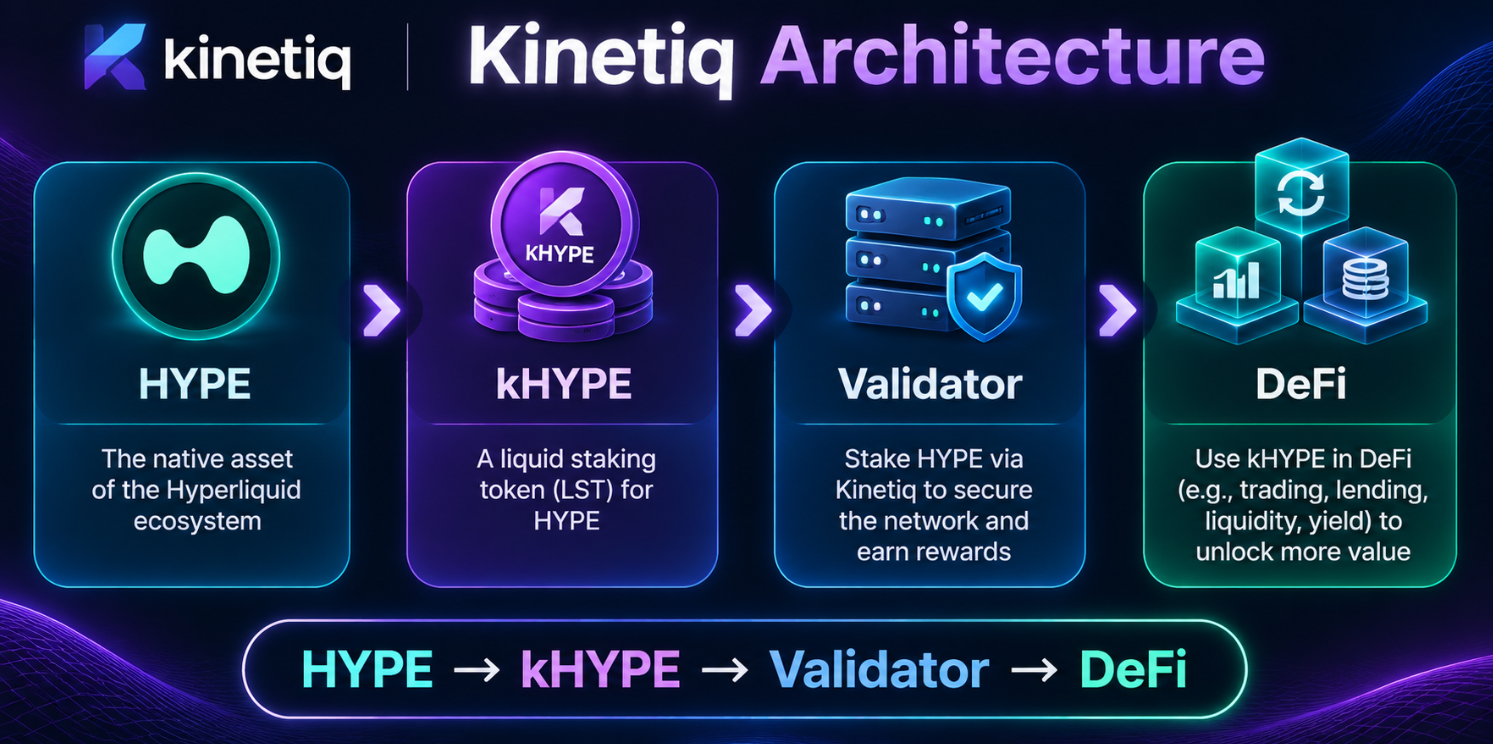
Kinetiq converts deposited HYPE into a liquid staking position represented by kHYPE, delegates the underlying stake across validators and passes staking rewards into the kHYPE exchange rate after fees. This lets users retain liquidity while supporting Hyperliquid’s validator set.
The basic flow is:
- A user moves HYPE to HyperEVM and deposits it into Kinetiq.
- Kinetiq issues kHYPE to the user.
- The protocol delegates HYPE through its validator infrastructure.
- Staking rewards accrue to kHYPE holders through the token’s accounting.
- The user can use kHYPE in supported DeFi venues or request unstaking.
According to the official kHYPE documentation, normal unstaking takes roughly eight to nine days because of Hyperliquid’s delegation lock and unstaking queue. A user seeking immediate liquidity may instead swap kHYPE, but that introduces market-price, liquidity and slippage risk.
How does Kinetiq generate revenue?
Kinetiq generates revenue from staking-performance fees, validator commissions, market-deployer and builder income, Launch revenue and Elysium sequencer activity. These streams do not have identical economics, and not all gross fees become protocol revenue.
For kHYPE, the official documentation states that Kinetiq charges 10% of staking rewards. Under KIP-2, 70% of that protocol revenue funds KNTQ buybacks and 30% supports treasury operations. Active-set validators that opt in share part of their validator commission with Kinetiq; Kinetiq directs its share to buybacks.
StakeHub is therefore more than a list of validators. It is the coordination layer through which performance, delegation and validator participation affect both kHYPE and Kinetiq’s revenue. Investors should monitor validator concentration and performance—not just total value locked.
Hyperliquid, HyperCore and HyperEVM are not interchangeable
Hyperliquid is the broader ecosystem, HyperCore is the native trading and staking environment, and HyperEVM is its EVM-compatible smart-contract layer. KNTQ is deployed on HyperEVM, while some KNTQ trading and fee activity occurs through Hyperliquid’s market infrastructure.
Moving assets between layers or chains can involve transfers, bridges and smart contracts. A ticker match alone is insufficient: always verify the network and full contract address.
3. What Products Form the Kinetiq Ecosystem?
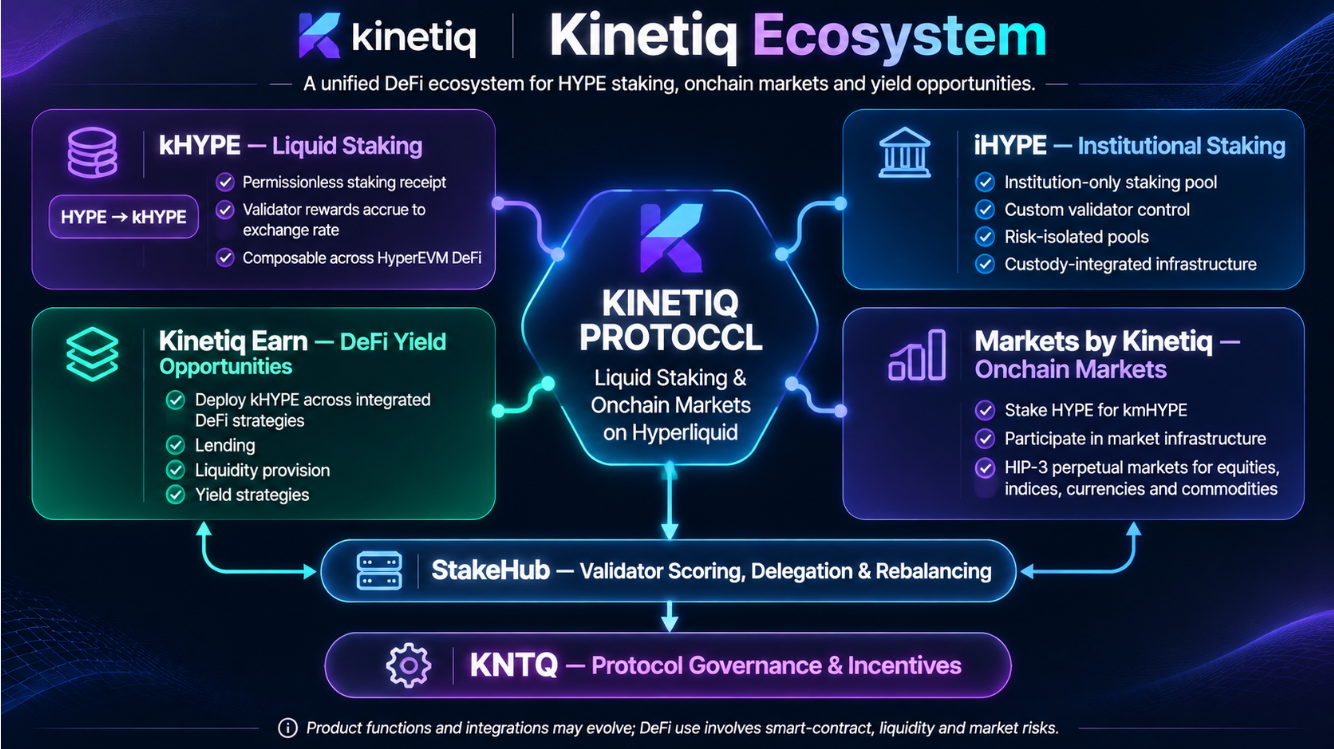
Kinetiq’s investment case now depends on four connected products: kHYPE liquid staking, Markets.xyz, Kinetiq Launch and Elysium. The important question is not how many products exist, but whether each generates durable users, fees and KNTQ buyback capacity.
kHYPE: the foundation
kHYPE is the most mature part of the stack. It lets users earn native HYPE staking rewards without giving up a transferable asset. Its health can be tracked through HYPE deposited, kHYPE liquidity, validator distribution, depeg behavior and redemption performance.
Third-party Reported: DeFiLlama showed approximately $875 million of Kinetiq TVL on November 10, 2026, down about 14.5% over 30 days. TVL is useful, but it is not revenue, profit or guaranteed sticky capital.
Markets.xyz: on-chain trading infrastructure
Markets.xyz provides perpetual markets that can include stocks, foreign exchange and commodities through Hyperliquid’s HIP-3 market-deployment model. Kinetiq’s disposable Markets income—defined in its documentation as at least 10% of deployer share plus builder-code revenue—is routed to KNTQ buybacks.
Investors should track actual market availability, not just announced instruments. Volume can disappear or markets can be delisted. A high notional trading volume also does not equal the same amount of protocol revenue.
Kinetiq Launch: stake-backed market deployment
Launch helps HIP-3 deployers crowdsource the stake required to operate markets through custom liquid-staking structures. This can expand Kinetiq’s revenue base if it attracts credible operators and sustained market use.
The core metric is not the number of launches alone. It is the economic activity those deployments retain after incentives fade.
Elysium: a high-performance network using HYPE as gas
Elysium is Kinetiq’s high-performance Layer 2 designed for Hyperliquid-connected applications. The public mainnet announcement described 100-millisecond blocks, HYPE as the gas asset and 50% of sequencer revenue allocated to open-market KNTQ purchases.
That design strengthens the value-capture story, but it remains an early execution bet. Investors need to verify real transactions, active applications, fee revenue, sequencer reliability and the actual buyback transactions. Network launch headlines are not the same as durable demand.
4. What Is KNTQ Used For?
KNTQ is used for Kinetiq governance, staking into sKNTQ and accessing tiered ecosystem benefits; it also captures value when defined protocol revenue is used for market buybacks. The token does not represent equity, a legal claim on Kinetiq’s treasury or a guaranteed yield.
KNTQ supply and distribution
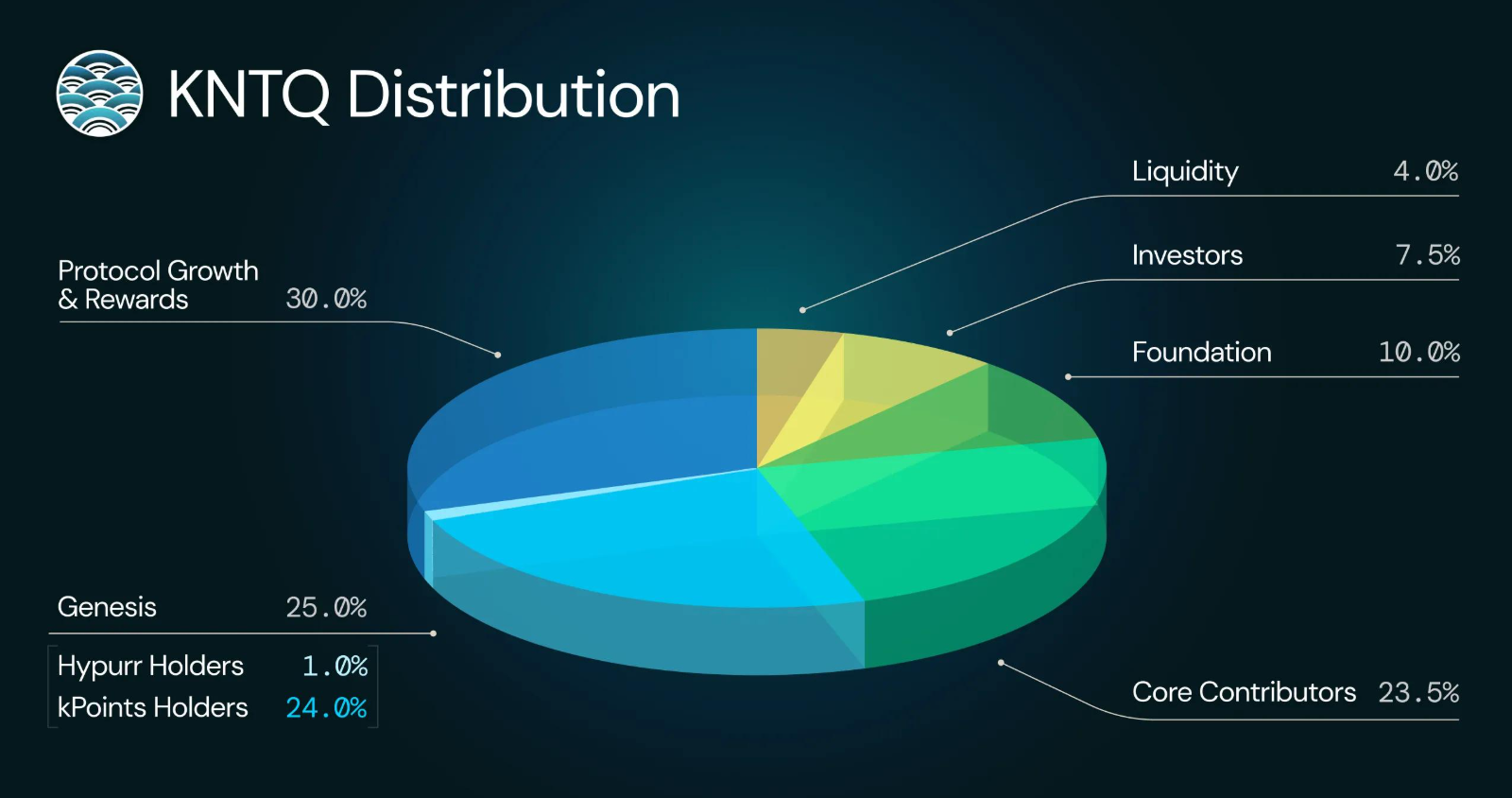
Officially Announced: KNTQ has a fixed maximum supply of 1,000,000,000 tokens. The published allocation is:
- 30% for Protocol Growth and Rewards.
- 25% for Genesis distribution, including 24% for kPoints holders and 1% for Hypurr holders.
- 23.5% for Core Contributors.
- 10% for the Kinetiq Foundation.
- 7.5% for Investors.
- 4% for Liquidity.
Allocation percentages do not reveal the full sell-pressure picture. Investors should also examine claim rates, vesting, treasury transfers, incentive emissions and exchange deposits.
What is sKNTQ?
sKNTQ is the staked form of KNTQ used for governance and selected ecosystem privileges. Official documentation states that unstaking has a seven-day withdrawal period.
Benefits are tiered rather than automatic for every holder. The published thresholds begin at 50,000 sKNTQ and can increase Markets referral share or kmHYPE minting allocation. Those thresholds are economically significant: a small retail holder should not assume the same benefits as a high-tier participant.
Most importantly, staking does not currently mean receiving the protocol’s KNTQ buybacks. That was part of the historical model, which KIP-5 changed.
How do KNTQ buybacks work?
Current Mechanism: defined shares of Kinetiq product revenue purchase KNTQ in the market, and purchased tokens are routed to the Hyperliquid Assistance Fund. Fees already paid in KNTQ can also be sent directly to that fund.
Official documentation lists the following value-accrual sources:
- 70% of KIP-2 protocol revenue funds buybacks; 30% supports treasury operations.
- 100% of Kinetiq’s share of active-set validator commissions funds buybacks.
- 100% of KNTQ trading fees received by the deployer goes directly to the Assistance Fund.
- 100% of Kinetiq’s disposable Markets.xyz income funds buybacks.
- 100% of Kinetiq’s share of Launch revenue funds buybacks.
- 50% of Elysium sequencer revenue is designated for open-market KNTQ purchases.
The economic chain is straightforward:
Product activity → protocol revenue → market purchases of KNTQ → Assistance Fund → lower market-available supply
However, “lower market-available supply” is more precise than “burned” unless the mechanism provably destroys the tokens or makes them irretrievable. Assistance Fund custody can remove tokens from active circulation, but investors should verify the address, transfers and policy rather than treating every buyback as an immutable burn.
KIP-5: historical mechanism versus current mechanism
KIP-5 redirected KNTQ buybacks from sKNTQ stakers to Hyperliquid’s Assistance Fund on September 16, 2026. This change is essential because older articles and exchange descriptions may still repeat the superseded model.
Historical Mechanism, through September 15, 2026:
Protocol revenue → open-market KNTQ purchase → distribution to sKNTQ stakers
Under that model, third-party materials sometimes quoted an annualized buyback yield of roughly 13%. That figure was historical, variable and based on a different distribution system. It should not be presented as a current or prospective sKNTQ yield.
Current Mechanism, from September 16, 2026:
Protocol revenue → open-market KNTQ purchase → Hyperliquid Assistance Fund
Officially Announced historical data: Kinetiq stated that it had bought back 5,391,458 KNTQ at an average price of about $0.15 before the KIP-5 change. This claim should be cross-checked against the relevant on-chain wallet history before being treated as independently verified.
KIP-5 improves the simplicity of the supply-removal thesis but weakens the direct cash-flow-like narrative for sKNTQ holders. sKNTQ still provides governance and tiered ecosystem benefits; it no longer receives those buyback distributions under the current design.
KNTQ unlock schedule
Core-contributor and investor tokens use a three-year schedule: a one-year cliff followed by two years of monthly linear vesting. A cliff means tokens do not vest gradually during the first year; a material amount can become available when the cliff ends, followed by monthly releases.
Third-party Reported / Estimated: DeFiLlama’s unlock calendar projected roughly 12.92 million KNTQ unlocking on November 27, 2026, equal to about 3.99% of the reported circulating supply at that time. An unlock is not automatically a sale, but it expands the potential sellable supply.
Investors should compare monthly unlock value with monthly buyback value. A protocol can buy back tokens while net liquid supply still increases if unlocks, incentives or treasury distributions are larger.
5. KNTQ Price, Market Cap and Liquidity
KNTQ traded near $0.40 on November 10, 2026, with a circulating market capitalization near $129 million and an FDV near $399 million, but these figures are third-party snapshots rather than fixed facts. The difference between market cap and FDV reflects the large share of supply not yet counted as circulating.
Third-party Reported by CoinGecko at review time: approximately 320 million KNTQ circulating, about $48 million in 24-hour volume, a historical high near $0.596 and a low near $0.0358. DeFiLlama and CoinMarketCap showed circulating supply closer to 324 million. Differences in timing and methodology are normal; the article should disclose them rather than selecting whichever number supports a preferred conclusion.
Liquidity must be separated from volume. CoinGecko reported Hyperliquid KNTQ/USDC as an active market with a tight displayed spread, while Kraken, LBank and MEXC also listed spot pairs. Yet reported volume can be concentrated in one pool or market, and two-percent order-book depth may be far smaller than daily volume.
Before placing a large order, compare:
- Bid-ask spread.
- Depth within 1% and 2% of the mid-price.
- Expected slippage for the intended order size.
- Spot volume versus perpetual volume.
- Deposit and withdrawal status.
- Price consistency across venues.
6. Where Can You Buy KNTQ?
KNTQ can be bought on confirmed venues including Hyperliquid, Kraken, MEXC and LBank; HiBT announced a KNTQ/USDT listing on November 10, 2026, but users should confirm the exact opening status and live liquidity before trading. Availability depends on location, account eligibility and venue rules.
How to buy KNTQ on HiBT
HiBT’s official announcement states that KNTQ/USDT will be listed. Because an “upcoming listing” can precede active trading, use the following status-aware process:
- Create a HiBT account through the official website and enable two-factor authentication.
- Complete any identity checks required for your region.
- Deposit USDT using a network supported by both the sending wallet and HiBT. Never assume that similarly named networks are interchangeable.
- Open the KNTQ/USDT market page.
- Confirm that trading is actually open, the order book contains executable bids and asks, and deposits or withdrawals have the expected status.
- Choose a limit order when price control matters. A market order prioritizes execution and may suffer greater slippage in a thin book.
- Review the filled quantity, average price and fee in order history.
If the page still shows zero price or zero volume, do not treat the pair name alone as proof of an active market. Use a confirmed venue or wait for HiBT’s opening notice and live order book.
How to buy KNTQ on Hyperliquid
Hyperliquid is the token’s native market context and supports KNTQ/USDC. A typical route is:
- Use an official Hyperliquid interface and connect a compatible wallet.
- Fund the account with the supported quote asset.
- Search for KNTQ and verify the official token identity.
- Review spread, depth and fees.
- Enter the order amount and confirm the trade.
- Verify the resulting balance and transaction or account record.
For direct HyperEVM token interactions, verify the contract:
0x000000000000780555bD0BCA3791f89f9542c2d6
How to buy KNTQ on a centralized exchange
Kraken has supported USD and EUR markets, while MEXC and LBank have supported KNTQ/USDT. Exact pairs, deposits, withdrawals and regional access can change. MEXC’s “Assessment Zone” labeling should be treated as a risk signal, not omitted from the analysis.
For beginners, a CEX can simplify order entry and account records. A DEX or native market offers self-custody and direct access but adds wallet, contract, network and slippage risks. Neither route is universally safer.
7. KNTQ Price Prediction: Bull, Base and Bear Cases
KNTQ’s future price should be modeled from protocol adoption, revenue, buyback capacity, unlocks and valuation—not a single chart target. With a one-billion-token maximum supply, each $0.10 of token price corresponds mathematically to roughly $100 million of FDV.
This creates simple valuation checkpoints:
- At $0.10, FDV would be $100 million.
- At $0.40, FDV would be $400 million.
- At $0.60, FDV would be $600 million.
- At $1.00, FDV would be $1 billion.
These are Estimated valuation scenarios, not forecasts.
Bull case
The bullish case requires multiple revenue engines to grow at the same time. kHYPE retains or expands its share of staked HYPE; validator commission grows; Markets and Launch generate durable income; Elysium attracts real applications; and on-chain buybacks remain large enough to offset new supply.
In this scenario, the market may assign KNTQ a premium as a diversified Hyperliquid infrastructure token rather than valuing it as a single-product liquid-staking governance token.
Base case
The base case is stable liquid staking but slower expansion elsewhere. kHYPE remains useful, while Markets, Launch and Elysium develop gradually. Buybacks continue but do not overwhelm unlocks. KNTQ then trades mainly on changing expectations for revenue growth and Hyperliquid risk appetite.
Bear case
The bearish case combines weaker activity with expanding supply. HYPE falls, kHYPE loses share, Markets volume or Elysium adoption disappoints, buybacks shrink and monthly unlocks add available tokens. A high FDV relative to current revenue can then compress even if the protocol remains operational.
Readers can use the KNTQ price prediction page as a supplementary sentiment tool, not as a guaranteed target. Bitcoin price analysis helps frame broad crypto risk appetite, while Ethereum price analysis can provide context for DeFi valuation. Neither substitutes for Kinetiq-specific revenue and supply research.
8. Is KNTQ a Good Investment?
KNTQ is investable only if you believe Kinetiq can turn Hyperliquid activity into persistent protocol revenue and that the current buyback mechanism can absorb enough supply; it is not yet a low-risk long-term holding. The protocol has more substance than a pure narrative token, but the valuation case remains sensitive to adoption and unlocks.
My framework uses six tests:
- Product adoption: Is kHYPE TVL stable and organic? Are Markets, Launch and Elysium gaining repeat users?
- Protocol revenue: Are fees converting into revenue rather than temporary incentive-driven activity?
- Buyback verification: Do Assistance Fund inflows and market purchases match published rules?
- Supply discipline: Are unlocks, incentives and treasury transfers manageable relative to market depth?
- sKNTQ utility: Do governance and tier benefits create genuine demand without relying on outdated yield claims?
- Valuation: Does current FDV already price in success across all four business lines?
Short-term strategy
Short-term traders should prioritize liquidity, event risk and spot confirmation. Watch four-hour and daily trend structure, volume, order-book depth, large wallet transfers and the November 27 unlock. Perpetual volume is not spot demand, and positive momentum does not remove the risk of a thin exit.
Avoid using high leverage around unlocks, listings or Elysium announcements. A new listing can improve access but also lets earlier holders sell into new demand.
Medium-term strategy
A one-to-three-month thesis should be conditional on revenue-backed buybacks. Review monthly kHYPE TVL, validator participation, Markets income, Launch deployments, Elysium fees, buyback amount, Assistance Fund balance and circulating supply.
A reasonable medium-term entry plan uses tranches: a small observation position, a second allocation after revenue confirmation and a final allocation only if price strength is supported by deeper liquidity. This avoids converting a headline into a full-size position.
Long-term strategy
Long-term holders are underwriting Kinetiq’s role as Hyperliquid infrastructure. The thesis requires kHYPE competitiveness, functioning governance, expanding product revenue and durable alignment between protocol use and KNTQ demand.
The strongest long-term evidence would be rising revenue per unit of TVL, diversified revenue beyond kHYPE and Assistance Fund accumulation that remains meaningful after unlocks. The weakest setup would be high TVL but low net revenue, shrinking secondary products and token demand driven mainly by speculation.
Position sizing
For a high-risk token, size from acceptable loss rather than upside hopes:
[ \text{Position Size}=\frac{\text{Maximum Acceptable Loss}}{\text{Stop-Loss Distance}} ]
If the maximum acceptable loss is $20 and the planned stop is 10% below entry, the theoretical position is $200. In a thin market, reduce it further because slippage may make the realized loss larger than planned.
9. KNTQ vs FLOAT: Similar Buyback Language, Different Businesses
KNTQ and FLOAT can both use platform activity to fund token purchases, but the underlying businesses and risk drivers are different. KNTQ depends on liquid staking and a wider Hyperliquid infrastructure stack; FLOAT depends more directly on launchpad trading activity and its fee-allocation rules.
KNTQ’s advantage is revenue diversification across staking, validator commissions, Markets, Launch and Elysium. Its disadvantage is complexity: more products mean more execution, integration and governance risk.
FLOAT’s model can be easier to understand but more dependent on sustained launchpad attention and liquidity. Readers comparing revenue-linked tokens can review this FLOAT token analysis, while keeping the two valuation frameworks separate.
10. What Are the Main Risks of KNTQ?
KNTQ combines liquid-staking, smart-contract, governance, unlock, ecosystem and market-liquidity risks. A real product and audited code reduce some uncertainty, but they do not eliminate loss scenarios.
Liquid-staking and depeg risk
kHYPE can trade below its implied HYPE redemption value when liquidity is weak or confidence falls. Native unstaking takes time, and instant exits may incur slippage. Validator problems, lower staking yield or protocol failure can also weaken kHYPE demand.
Smart-contract and operational risk
Kinetiq publishes contract addresses and multiple audit reports from firms including Spearbit, Cantina, Code4rena, Zenith and Pashov Audit Group. Officially Announced: these reviews cover several components across different dates. An audit does not guarantee that every current contract, integration or upgrade is bug-free.
Investors should inspect administrator, pauser and upgrade permissions. Elysium adds bridge, sequencer and L2 operational risks to the existing staking stack.
Buyback-policy risk
KIP-5 demonstrates that governance can change who receives the economic benefit of buybacks. Future governance can change allocations again. Revenue may decline, purchases may be small relative to market cap and Assistance Fund custody is not identical to cryptographic burning.
Unlock and concentration risk
The one-year cliff and subsequent monthly vesting create recurring potential supply. Protocol Growth and Rewards allocations may also enter circulation. Monitor recipient wallets and exchange deposits instead of assuming every unlock is sold—or assuming none will be.
Hyperliquid dependency
Kinetiq is highly exposed to Hyperliquid’s activity, HYPE price, validator economics and regulatory environment. A slowdown in on-chain derivatives, stronger competing LSTs or adverse policy changes can affect multiple Kinetiq products at once.
Pre-purchase verification checklist
- Confirm the full KNTQ contract address and HyperEVM network.
- Check current circulating supply and the next unlock date.
- Verify KIP-5 buyback and Assistance Fund transactions on-chain.
- Confirm sKNTQ staking, benefit tiers and seven-day withdrawal terms.
- Review kHYPE TVL, liquidity and redemption conditions.
- Check Markets, Launch and Elysium revenue rather than product announcements alone.
- Compare buyback value with unlock value.
- Inspect the order book or pool depth for your intended trade size.
- Confirm exchange deposits and withdrawals, not just trading-page existence.
- Use only funds you can afford to lose.
11. Frequently Asked Questions About Kinetiq and KNTQ
Kinetiq is a Hyperliquid-native infrastructure protocol, while KNTQ is its HyperEVM governance and value-accrual token; the answers below summarize the distinctions, buying channels and principal risks.
What is Kinetiq?
Kinetiq is a Hyperliquid-native liquid-staking and financial-infrastructure protocol. Its products include kHYPE, Markets.xyz, Kinetiq Launch and Elysium.
What is KNTQ crypto?
KNTQ is Kinetiq’s governance and value-accrual token on HyperEVM. It can be staked into sKNTQ and is bought back using defined shares of protocol revenue.
What blockchain is KNTQ on?
KNTQ is deployed on HyperEVM, the EVM-compatible execution environment within the Hyperliquid ecosystem.
What is the KNTQ contract address?
The official HyperEVM contract is 0x000000000000780555bD0BCA3791f89f9542c2d6. Verify it through Kinetiq’s official contracts page and HyperEVMScan.
Where can I buy KNTQ?
Confirmed markets include Hyperliquid, Kraken, MEXC and LBank. HiBT officially announced KNTQ/USDT on November 10, 2026; verify that the market is open and liquid before trading.
What is the total supply of KNTQ?
KNTQ has an officially announced maximum supply of 1 billion tokens. Third-party trackers reported roughly 320–324 million circulating on November 10, 2026.
What is kHYPE?
kHYPE is Kinetiq’s liquid-staking token for HYPE. It accrues staking rewards and can be used in supported DeFi applications, but it carries smart-contract, depeg and liquidity risks.
What is sKNTQ?
sKNTQ is the staked representation of KNTQ. It is used for governance and tiered benefits, with a seven-day unstaking withdrawal period.
Does KNTQ have a buyback mechanism?
Yes. Under the current KIP-5 mechanism, defined shares of Kinetiq revenue buy KNTQ in the market and send it to the Hyperliquid Assistance Fund. This replaced the earlier distribution of bought-back tokens to sKNTQ stakers.
Is KNTQ a good investment?
KNTQ may suit investors seeking high-risk exposure to Hyperliquid infrastructure and protocol-revenue buybacks. It is unsuitable for anyone who cannot tolerate sharp drawdowns, unlock pressure or smart-contract risk.
Final Verdict
Kinetiq is one of the more credible revenue-linked infrastructure projects in the Hyperliquid ecosystem, but KNTQ should still be treated as an early, high-risk asset. The strongest part of the thesis is the explicit connection between several protocol revenue streams and market buybacks. The weakest parts are product-execution risk, a large non-circulating supply, changing governance policy and dependence on Hyperliquid.
My position is therefore conditional rather than promotional: KNTQ deserves active research, but not blind conviction. A long-term upgrade requires three things to happen together—Kinetiq’s products must gain real users, those users must generate verifiable revenue, and buybacks must remain meaningful after unlocks and other selling pressure.
Do not evaluate KNTQ by asking only whether the token can rise. Ask whether protocol activity → net revenue → verified buybacks → lower market-available supply is strengthening each month. If that chain weakens, the investment thesis should be reduced before the narrative changes.
Sources and Data Classification
- Kinetiq KNTQ documentation — Officially Announced supply, vesting, sKNTQ and current value-accrual rules.
- Kinetiq kHYPE documentation — Officially Announced staking, fee and unstaking mechanics.
- Kinetiq contracts and audits — official contract list and audit index; contract state should be On-chain Verified.
- KIP-5 announcement — Officially Announced change from historical to current buyback destination.
- DeFiLlama Kinetiq dashboard — Third-party Reported TVL, revenue and unlock estimates.
- CoinGecko KNTQ market page — Third-party Reported prices, market cap, volume and exchange markets.
- HiBT’s November 10, 2026 listing announcement — Officially Announced upcoming KNTQ/USDT support; live status must be rechecked before publication.