
What is BABAON? Is it a cryptocurrency issued by Alibaba, or a tokenized stock linked to Alibaba's US-listed ADR price? Does buying BABAON equal holding BABA shares directly in a traditional securities account?
These questions determine how investors should analyze BABAON.
BABAON—also commonly written as BABAon—is the Alibaba Tokenized Stock within Ondo's tokenized equity ecosystem. Its core economic exposure comes from Alibaba Group Holding Limited's BABA ADR, which trades on US markets.
Although it can be traded in crypto markets against USDT, BABAON is not an ordinary cryptocurrency that derives value from tokenomics, community hype, burn mechanisms, or public-chain ecosystems.
The key driver of BABAON's medium- and long-term price remains Alibaba's corporate fundamentals: the profitability of Taobao and Tmall, Alibaba Cloud growth, AI commercialization, international e-commerce spending, free cash flow, share buybacks, and the broader market valuation of Chinese tech stocks.
At the same time, as an RWA and tokenized stock, BABAON introduces risks that traditional BABA shares do not—or express differently—including issuance structure, underlying asset custody, smart contracts, on-chain liquidity, exchange platforms, and regional regulatory restrictions.
Therefore, researching BABAON requires answering at least four questions:
- Can Alibaba's future earnings continue to grow?
- Can cloud computing and AI become new valuation drivers?
- Does the current BABA stock valuation already reflect these expectations?
- Is BABAON's price, liquidity, and asset structure reasonable?
Risk Disclosure: This article is for asset mechanism introduction, company fundamental research, and investment education purposes only. It does not constitute investment advice, performance guarantees, or trading recommendations. BABAON may be affected simultaneously by BABA stock price, China's economy, Alibaba's operating performance, Chinese ADR policies, Ondo's product structure, on-chain infrastructure, and market liquidity. Before trading, verify Ondo's and platform-specific product documents, supported networks, investor eligibility, and regional restrictions.
1. What is BABAON? Why is Alibaba stock appearing in Crypto markets?
BABAON is a tokenized stock product linked to Alibaba's US-listed ADR, falling into the categories of RWA and Tokenized Equity.
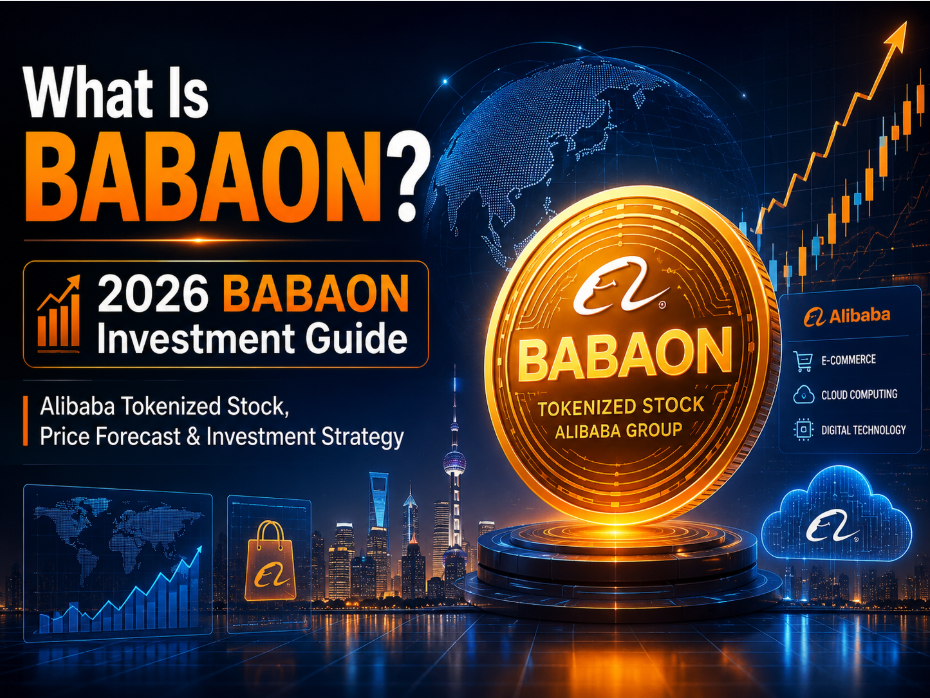
Its primary goal is to enable eligible users to gain economic exposure to BABA stock performance through blockchain and crypto trading environments.
You can view BABAON real-time price and BABAON/USDT market data to see the latest quotes, 24-hour change, trading volume, and market trends.
However, a price page only shows what BABAON is currently trading at. It does not, by itself, prove how the underlying assets are custodied, nor does it guarantee that BABAON will always trade exactly in line with BABA stock at all times.
Is BABAON an ordinary cryptocurrency?
BABAON exists in token form and can be traded in certain on-chain or crypto venues, but it is not a crypto-native asset like BTC, ETH, meme coins, or DeFi governance tokens.
When analyzing typical crypto projects, investors might look at:
- Total token supply;
- FDV;
- Unlock schedules;
- Staking;
- Protocol revenue;
- Burn mechanisms;
- Community size;
- On-chain users.
When analyzing BABAON, the more important metrics are:
- Alibaba revenue;
- Adjusted EBITA;
- EPS;
- Free cash flow;
- Taobao & Tmall growth;
- Alibaba Cloud revenue;
- AI business development;
- International e-commerce losses;
- Share buybacks;
- BABA valuation;
- BABAON's premium or discount to underlying assets.
Therefore:
BABAON is not a typical altcoin where you ask "will the project team pump it." Its long-term value comes first from Alibaba itself.
BABAON is not "Alibaba Coin"
BABAON is not a corporate cryptocurrency issued by Alibaba, nor does it mean Alibaba is building a public chain called BABAON.
It is NOT:
- An official Alibaba loyalty point;
- A Taobao token;
- An Alipay token;
- An Alibaba Cloud blockchain token;
- An Alibaba L1 or L2 network asset;
- An Alibaba-issued fundraising token.
BABAON is a stock tokenization product offered by third-party financial institutions.
This means Alibaba primarily runs its business operations, while Ondo and related financial and blockchain infrastructure handle the tokenized product's issuance, asset backing, circulation, and compliance arrangements.
What does "ON" in BABAON mean?
In Ondo's tokenized stock ecosystem, some products append "ON" to the traditional stock ticker for identification.
For example:
- BABA → BABAON;
- NVDA → NVDAON;
- GOOGL → GOOGLON.
"ON" generally denotes an Ondo-series tokenized stock product and does not mean the underlying company's traditional ticker has changed. Alibaba's stock code on NASDAQ or NYSE remains BABA.
2. Does buying BABAON equal buying Alibaba stock?
Not exactly.
BABAON and BABA may offer highly correlated economic exposure, but their holding structures, trading venues, custody arrangements, legal rights, and regulatory environments can differ.
Which Alibaba stock does BABAON track?
Alibaba Group is listed on both US and Hong Kong capital markets.
In the US, the primary ticker is BABA as an ADR; in Hong Kong, it trades as 9988.HK.
BABAON primarily references the economic performance of the US-listed BABA ADR and should not be directly compared share-for-share with 9988.HK.
BABA ADR and Hong Kong ordinary shares are economically linked, but they differ in unit size, pricing currency, trading hours, market participants, and short-term supply/demand dynamics.
Investors should distinguish among:
- BABA: US-listed ADR;
- 9988.HK: Hong Kong-listed stock;
- BABAON: On-chain tokenized asset linked to BABA ADR.
Why does BABAON track BABA price?
The theoretical price transmission works as follows:
Alibaba's business performance affects revenue, profit, and cash flow; the market reprices BABA based on growth, risk, and valuation; Ondo's product establishes a reference value for BABAON based on the underlying asset and its economic performance; and BABAON then discovers price through crypto trading venues.
Thus, when Alibaba beats earnings estimates, Alibaba Cloud accelerates, or Chinese tech stocks rally overall, both BABA and BABAON may benefit.
If Alibaba earnings decline, the China ADR risk premium rises, or global tech valuations contract, BABAON may come under pressure.
Does holding BABAON make me an Alibaba shareholder?
Not directly.
Traditional BABA stock is typically held by investors through brokerage accounts, with corresponding shareholder rights under securities regulations.
What rights BABAON holders receive depends on Ondo's product documentation, including:
- Whether voting rights exist;
- How dividends are handled;
- Whether corporate actions can be participated in;
- Whether direct ownership of underlying shares is granted;
- Whether minting and redemption are supported;
- Which users are eligible for redemption;
- Who custodies the underlying assets;
- What happens if the issuer faces issues.
A more accurate statement is:
BABAON primarily provides users with economic exposure to BABA stock, but should not be automatically understood as holding BABA ordinary securities directly in a traditional brokerage account or Alibaba shareholder register.
3. How does Ondo tokenize Alibaba stock?
Ondo Global Markets aims to bring the economic value of traditional stocks and ETFs into blockchain environments, enabling eligible non-US investors to gain traditional market exposure through on-chain infrastructure.
What role does Ondo Finance play?
According to Ondo's public materials, its tokenized stock framework uses traditional financial infrastructure, asset-backed arrangements, and blockchain tokens to bring economic exposure to corresponding stocks or ETFs on-chain.
In simplified terms:
Traditional securities exist within regulated financial and custody systems; Ondo uses appropriate issuance and legal structures to take on underlying asset value; blockchain tokens are issued; and users trade the asset through wallets, on-chain protocols, or supported platforms.
However, the actual structure may involve issuing entities, broker-dealers, custodians, special-purpose vehicles, and redemption mechanisms. It is more complex than simply "putting a stock on-chain."
What does 1:1 backing mean?
1:1 backing generally indicates a corresponding relationship between token supply and the underlying asset or economic exposure.
This mechanism helps BABAON stay close to BABA's reference value, with minting, redemption, and market-making arbitrage reducing prolonged price deviations.
But 1:1 backing does not mean zero risk, nor that BABAON and BABA trade at identical prices every second.
Investors should still verify:
- The ratio;
- Underlying asset type;
- Custodian;
- Asset segregation;
- Attestation or audit frequency;
- Redemption eligibility;
- Product fees;
- Jurisdictions;
- Treatment in issuer bankruptcy.
Why might BABAON temporarily deviate from BABA price?
BABAON and BABA can diverge in the short term due to:
- Shallow BABAON market depth;
- Wide bid-ask spreads;
- US markets being closed;
- Crypto markets still trading;
- Market-maker quote adjustments;
- Minting/redemption inefficiencies;
- Insufficient cross-chain liquidity;
- Extreme market conditions;
- Platforms suspending deposits or withdrawals;
- Concentrated buying or selling.
If BABA's reference value is $120 and BABAON trades at $124, the token may be at a premium. If BABAON trades at $116, it may be at a discount.
Actual assessment should also consider unit sizes, product fees, accrued income, dividend treatment, data update times, and whether US markets are open.
Why is BABAON considered an RWA?
RWA stands for Real World Assets.
BABAON brings the economic value of Alibaba stock from traditional capital markets onto the chain, so it qualifies as:
- Tokenized Equity;
- Tokenized Stock;
- RWA;
- On-chain securities economic exposure.
Its value source remains a real-world company and securities, not an independent crypto protocol.
4. What truly drives BABAON's price is Alibaba's fundamentals
Analyzing BABAON requires more than just crypto candlesticks and USDT volume.
The long-term value ultimately depends on whether Alibaba can grow revenue, profit, cash flow, and per-share value.
Are Taobao and Tmall still the cash-flow foundation?
Taobao and Tmall form the core of Alibaba's China e-commerce business.
Key metrics for this segment include:
- GMV;
- User purchase frequency;
- Merchant count;
- Customer management revenue;
- Ad and recommendation efficiency;
- Take rate;
- Merchant services;
- Price competition;
- Segment margins.
Alibaba faces competition from Pinduoduo, JD.com, Douyin e-commerce, and other platforms. If the company continues to increase subsidies to maintain market share, GMV and user activity may rise, but margins may not improve in tandem.
So investors should not just ask "are Taobao users growing?" but also:
Can Taobao and Tmall sustain reasonable profits and free cash flow while staying competitive?
How does China's consumption environment affect Alibaba?
Alibaba's e-commerce business is influenced by Chinese consumption, employment, consumer confidence, and retail trends.
When consumer willingness rises, platform transactions, advertising, and merchant spending tend to grow. If the economy faces headwinds, consumers may favor lower prices, and subsidy/price competition among platforms could intensify.
Therefore, BABAON investors should monitor:
- China's retail sales of consumer goods;
- Household income and employment;
- Consumer confidence;
- E-commerce penetration;
- Platform competition;
- Merchant operating conditions.
Why is Alibaba Cloud a key valuation variable?
Alibaba Cloud transforms Alibaba from just a traditional e-commerce platform.
Cloud offerings include:
- Enterprise cloud services;
- Compute and storage;
- Databases;
- AI compute power;
- Large-model services;
- Enterprise digitalization;
- Data centers;
- Networking and security.
If Alibaba Cloud regains faster growth and increases customer demand and per-customer value through AI, the market may assign a higher tech/cloud valuation to Alibaba.
But the cloud business also faces:
- Competition in China's cloud market;
- Corporate IT budgets;
- AI chip supply;
- Data center capex;
- Price competition;
- Customer migration costs;
- AI commercialization speed.
Can AI become Alibaba's second growth curve?
Alibaba has cloud computing, enterprise customers, e-commerce scenarios, and vast data—all of which provide a foundation for AI product commercialization.
Potential AI applications include:
- Cloud-based model training and inference;
- Enterprise large-model services;
- E-commerce recommendations;
- Ad optimization;
- Intelligent customer service;
- Merchant content generation;
- Supply chain and logistics optimization;
- Office collaboration.
But AI investment does not automatically translate into profit.
Investors should track:
- AI-related cloud revenue;
- Paying customers;
- Inference and training demand;
- AI capex;
- Unit compute costs;
- Gross margins;
- Actual AI product take rates;
- ROI on AI spending.
Is international e-commerce a growth engine or profit drag?
Alibaba's international businesses include AliExpress, Lazada, Trendyol, and related logistics services.
International e-commerce can expand overseas reach and revenue, but may also incur high costs, including:
- Customer acquisition;
- Advertising;
- Subsidies;
- Cross-border logistics;
- Local warehousing;
- Returns;
- Local compliance;
- Competition with global platforms.
When assessing international operations, look beyond order and revenue growth to whether losses are narrowing and when sustainable profits might emerge.
Why do share buybacks affect BABAON?
When Alibaba uses cash to repurchase shares and cancel or reduce outstanding shares, earnings per share may rise even if total profit stays flat.
The basic transmission:
Buybacks reduce share count → EPS and free cash flow per share may improve → the market revalues BABA on a per-share basis → BABAON follows the economic exposure.
However, whether buybacks create value depends on the repurchase price. Buying back at significantly overvalued levels may be less efficient; doing so at low valuations with ample cash tends to be more positive over time.
5. Why does BABAON rise? Six factors for an analytical framework
1. Alibaba earnings beat expectations
Key metrics include:
- Revenue;
- Adjusted EBITA;
- EPS;
- Free cash flow;
- Segment revenues;
- Management guidance;
- Share buybacks.
Markets care not just about year-over-year growth but also how actual results compare to consensus expectations. A strong report that still falls short of elevated whispers may still see BABA and BABAON decline.
2. Alibaba Cloud and AI revenue growth
If Alibaba Cloud returns to faster growth and AI products generate meaningful revenue, the market may re-rate Alibaba's valuation multiple upward.
Conversely, if AI spending grows but revenue and profits do not materialize, expectations may be trimmed.
3. Broad China tech sector valuation recovery
BABA does not trade in isolation. When the Hang Seng Tech Index, Chinese ADRs, and internet platforms see inflows, BABA may benefit from sector-wide multiple expansion. If investors demand higher risk premiums for China assets, even stable operations may see valuation pressure.
4. Global interest rates and liquidity
Lower rates typically support long-duration growth asset valuations, though actual impact also depends on economic growth, inflation, and risk appetite.
You can reference BTC price predictions and market cycles to gauge crypto risk appetite and dollar liquidity, and combine with ETH price predictions and Ethereum trends to assess on-chain finance and RWA market activity.
BTC and ETH do not directly boost Alibaba's profits, but they can influence:
- USDT capital activity;
- Crypto investor risk appetite;
- BABAON trading volume;
- Tokenized stock market demand;
- Short-term premiums or discounts.
5. CNY, USD, and China's macro environment
BABA trades in USD in the US, but Alibaba's revenue, costs, and assets are heavily tied to China.
CNY exchange rate changes can affect:
- USD-denominated financials;
- Offshore investor returns;
- China asset valuations;
- Cross-border capital flows.
On the macro front, watch:
- China GDP;
- Consumption;
- E-commerce retail;
- Corporate investment;
- Policy environment;
- Market interest rates.
6. Continued expansion of the RWA market
If more crypto users embrace tokenized stocks, BABAON may gain:
- Higher trading volume;
- More holders;
- More platform support;
- Deeper on-chain liquidity;
- Greater market attention.
But RWA market expansion primarily improves BABAON's trading conditions—it does not automatically improve Alibaba's earnings.
6. How should you interpret BABAON price predictions?
You can check BABAON price predictions and market trends to observe price action across different timeframes.
But BABAON price predictions should not be reduced to a single fixed target.
First forecast BABA, then analyze BABAON
A more logical sequence:
Estimate Alibaba's future revenue, profit, EPS, and free cash flow; judge what valuation the market might assign; arrive at a reasonable price range for BABA; and then factor in BABAON's structure, fees, liquidity, and premium/discount to determine token price.
A simplified stock valuation:
Future EPS × reasonable P/E = BABA valuation baseline.
But P/E is not fixed. It depends on growth rates, business quality, macro risks, policy, competition, and market sentiment.
Optimistic scenario
An optimistic scenario may require:
- China consumption recovery;
- Stable competition for Taobao/Tmall;
- Improved customer management revenue;
- Alibaba Cloud returning to faster growth;
- AI revenue expanding consistently;
- International losses narrowing;
- Strong free cash flow;
- Ongoing buybacks;
- Lower China tech risk premium;
- BABAON liquidity improving without severe premium.
In that environment, Alibaba's earnings and valuation could both improve, benefiting BABAON.
Neutral scenario
A neutral scenario might include:
- China e-commerce remaining stable;
- Cloud growing moderately;
- AI gradually commercializing;
- International business still investing;
- Buybacks continuing;
- No significant valuation expansion.
Under this case, BABAON may follow actual earnings growth rather than rely on rapid multiple expansion.
Pessimistic scenario
A pessimistic scenario might include:
- Intensified e-commerce competition;
- Subsidies compressing margins;
- Alibaba Cloud growth below expectations;
- AI capex failing to translate into revenue;
- International losses persisting;
- China economy under pressure;
- CNY weakening;
- Higher China ADR risk premium;
- Global tech valuation contraction;
- BABAON illiquidity or discount.
Price predictions should be treated as scenario analysis, not price commitments.
7. Who is BABAON suitable for?
Investors bullish on Alibaba but accustomed to using USDT
This is the most direct potential user base. They are not looking to speculate on a new token, but rather to gain Alibaba stock exposure within their crypto accounts.
Even so, they must understand the differences between BABAON and traditional stock accounts in terms of legal rights, custody, and liquidity.
Investors bullish on China internet, cloud computing, and AI
BABAON can be seen as a combination of:
- China internet platforms;
- E-commerce;
- Cloud computing;
- AI;
- International e-commerce;
- Share buybacks.
But the more layers in the thesis, the more research is required. A significant miss in any core business can affect the overall valuation.
Investors looking to add traditional assets to their crypto portfolios
Some may already hold BTC, ETH, and stablecoins and want to add traditional equity exposure via tokenized stocks.
This can improve asset-class diversity, but BABAON is not a stablecoin or low-volatility asset. It still carries:
- Equity market volatility;
- China asset risk;
- Tech valuation risk;
- Tokenization structural risk.
8. BABAON investment strategies: don't trade it like a meme coin
Fundamental long-term allocation
Suitable for investors who truly believe in Alibaba's value over the next three to five years.
You need to consistently track:
- Taobao & Tmall;
- Alibaba Cloud;
- AI commercialization;
- International business;
- Adjusted EBITA;
- Free cash flow;
- Share buybacks;
- Valuation.
Long-term holding cannot rely solely on "Alibaba was big in the past" or "the stock used to be higher." What truly matters is whether future earnings and capital returns can improve.
Post-earnings trend confirmation
Investors who want to avoid pre-earnings gap risk can wait until after Alibaba reports results.
The sequence:
Earnings released → BABA reacts initially → analysts and markets digest the data → observe whether BABAON follows in tandem → then assess if the trend is confirmed.
This may mean missing some of the initial move, but it reduces the risk of purely guessing earnings outcomes.
Dollar-cost averaging (DCA)
For volatile stock-related assets, deploying all capital at once concentrates entry timing.
For example, if you plan to allocate 1,000 USDT, split it into four parts for:
- Establishing a watch position;
- Waiting for earnings confirmation;
- Waiting for cloud/AI trend confirmation;
- Keeping dry powder for reasonable pullbacks or new information.
25% is just a capital-management illustration, not a fixed recommendation for all investors.
DCA does not replace stop-loss discipline. If fundamentals deteriorate, mechanically adding to positions can amplify losses.
Valuation-range strategy
Since BABAON is backed by a stock, using a valuation framework is usually more meaningful than just watching RSI.
Pay attention to:
- P/E;
- Forward P/E;
- Free cash flow yield;
- EV/EBITA;
- Alibaba Cloud's implied value;
- Peer company valuations;
- Historical valuation ranges;
- China tech risk discount.
Even if Alibaba's fundamentals improve, if BABA already prices in years of optimistic growth, the margin of safety may be thin.
Control concentration in similar tech assets
If you hold BABAON, XAVGO, XAAOI, and XARM simultaneously, you may have four different tickers but your portfolio may still be heavily exposed to:
- Tech stocks;
- AI investment;
- Global liquidity;
- High-growth valuation assets;
- Risk appetite.
To research AI infrastructure chips and enterprise software, read what XAVGO is and Broadcom's investment thesis.
To understand 800G, 1.6T optical modules, and AI data-center high-speed interconnect, read what XAAOI is and Applied Optoelectronics' investment thesis.
To research CPU architecture, ARM servers, and Edge AI, read what XARM is and Arm Holdings' investment thesis.
More tickers do not automatically mean true diversification. Check whether underlying earnings drivers are highly correlated.
9. How do BABAON, XARM, XAVGO, and XAAOI differ?
BABAON: Internet platform, cloud computing, and China consumption
BABAON's core thesis is:
- China e-commerce;
- Taobao & Tmall;
- Alibaba Cloud;
- AI commercialization;
- International e-commerce;
- China tech valuation;
- Share buybacks.
It is influenced by both tech growth and China consumption/macro factors.
XARM: CPU architecture and AI chip ecosystem
After reading what XARM is, you'll see XARM revolves around:
- CPU architecture;
- IP licensing;
- Royalty revenue;
- ARM servers;
- PCs;
- Automotive;
- Edge AI.
XARM is more of a semiconductor IP and computing-architecture asset.
XAVGO: AI ASIC, networking, and VMware
Understanding XAVGO reveals Broadcom's three-layer thesis:
- Custom XPUs;
- AI networking;
- VMware infrastructure software.
XAVGO is closer to AI compute and enterprise infrastructure.
XAAOI: 800G and 1.6T optical communications
After reading what XAAOI is, you'll see it is driven by:
- AI data-center builds;
- 800G orders;
- 1.6T mass production;
- Optical module capacity;
- Hyperscaler customers;
- Gross margins.
Therefore:
BABAON is closer to a China AI internet platform, XARM to chip IP, XAVGO to custom AI compute and networking, and XAAOI to AI data-center optical communications.
These can form an AI-themed cluster, but they do not share identical risks or achieve full diversification.
10. What are the risks of BABAON?
Alibaba fundamental risks
Key areas:
- China e-commerce competition;
- Taobao/Tmall market share;
- Cloud business growth;
- AI investment returns;
- International profitability;
- Margins;
- Capital allocation.
China macro risks
Consumption, employment, real estate, consumer confidence, and corporate investment can all indirectly affect Alibaba's business.
China ADR regulatory and geopolitical risks
BABA ADR may be affected by:
- Chinese regulation;
- US regulation;
- Audit rules;
- ADR policies;
- Cross-border capital markets;
- Geopolitics;
- Export restrictions;
- Investor risk appetite.
Even if Alibaba operates steadily, changes in the China ADR risk premium can affect valuation.
Tokenization issuance structure risk
BABAON is not BABA stock held in an ordinary brokerage account.
Investors must verify:
- Issuer;
- Custodian;
- Underlying assets;
- Asset segregation;
- Redemption;
- Legal recourse;
- Investor eligibility;
- Product fees.
Smart contract and cross-chain risks
Traditional BABA stock does not have smart-contract vulnerabilities, but once BABAON is on-chain, new risks emerge:
- Smart contract risk;
- Wallet risk;
- Bridge risk;
- Private key risk;
- Network congestion;
- Counterfeit tokens;
- Wrong-chain transfers.
Ondo's expansion of BABAON across multiple chains improves accessibility, but more cross-chain complexity means more technical risk to manage.
Liquidity risk
BABA US stock may have deep liquidity, but BABAON/USDT on a particular platform may not share the same depth.
Distinguish between:
Underlying stock liquidity vs. specific token-pair liquidity.
With a thin order book, large market orders can cause significant slippage.
Trading-hour mismatch risk
US stocks have fixed trading sessions; tokenized stocks may trade or transfer over longer periods.
If major news breaks while US markets are closed, BABAON may price first based on crypto bid/ask. When BABA reopens, the two may converge—or the earlier move may prove overdone.
FX and stablecoin risks
BABAON trades in USDT, so investors also bear stablecoin, exchange, and deposit/withdrawal risks. BABA's business involves substantial CNY exposure, so CNY/USD moves can also affect market valuations.
11. How to buy BABAON? Five checks before trading
1. Confirm the asset name
First, verify that you are trading the Alibaba Tokenized Stock (Ondo) with ticker BABAON or BABAon. Do not rely solely on the "BABA" name; check platform announcements, issuance structure, supported networks, and contract addresses.
2. Check real-time market data
Use BABAON real-time price, charts, and market data to see latest quotes, changes, and volume.
3. Assess the BABA trend
Do not just look at BABAON's own short-term candles.
Before placing an order, also check:
- BABA US stock price;
- Whether US markets are open;
- Alibaba's latest earnings report;
- Any company or policy news;
- Overall China tech sector performance.
4. Examine bid-ask spread and market depth
Focus on:
- Best bid and best ask;
- Spread;
- Order-book depth;
- 24-hour volume;
- Estimated slippage for larger orders;
- BABAON's price deviation from BABA.
5. Set a risk budget
BABAON tracks real stock—it is not a low-risk stable asset.
Only allocate capital you can afford to lose, and define clearly:
- Maximum position size;
- Acceptable drawdown;
- Investment horizon;
- Conditions for invalidating the thesis;
- Whether to use a phased strategy;
- When to reassess.
12. What indicators to track for evaluating BABAON?
Alibaba quarterly revenue
See whether overall business keeps growing and which segments drive that growth.
Taobao & Tmall performance
Monitor users, GMV, customer management revenue, competitive spending, and margins.
Alibaba Cloud revenue
Whether cloud can return to faster growth is a key condition for a higher tech valuation.
AI-related revenue
Confirm that AI demand translates into real customers, cloud revenue, and profits—not just capex.
Adjusted EBITA
Helps track operating profit trends across core businesses, but should be combined with GAAP profit and cash flow.
Free cash flow
Determines the company's capacity for buybacks, investment, and capital returns.
Share buybacks
Track buyback size, actual execution, repurchase prices, and changes in outstanding shares.
BABA valuation
Check P/E, forward P/E, free cash flow yield, and historical valuation ranges.
BABAON on-chain metrics
On the RWA side, also track:
- BABAON circulating supply;
- Number of holders;
- On-chain trading volume;
- Exchange order books;
- Total Ondo Stocks size;
- Supported networks;
- Mint and redeem activity;
- Premium or discount.
These metrics help assess BABAON's trading quality but do not replace Alibaba's fundamentals.
13. BABAON FAQs
What coin is BABAON?
More accurately, BABAON is a tokenized stock and RWA asset linked to Alibaba's BABA ADR, not a traditional crypto-native project token.
What is the relationship between BABAON and BABA?
BABA is the ADR ticker for Alibaba in US markets; BABAON provides on-chain economic exposure linked to BABA.
Is BABAON officially issued by Alibaba?
No. BABAON is a tokenized stock product offered by third-party financial and blockchain infrastructure like Ondo, not a corporate cryptocurrency issued by Alibaba.
Does buying BABAON equal buying Alibaba stock?
Not exactly. They may offer similar economic exposure, but differ in shareholder rights, custody, redemption, trading venues, and regulatory structure.
Is BABAON backed by real stock?
Ondo's tokenized stock framework emphasizes backing by corresponding traditional assets. For specific underlying assets, custody, and legal structure, refer to the latest BABAON product documentation.
Why is BABAON's price close to BABA?
Underlying asset backing, market-making, minting, redemption, and arbitrage mechanisms help BABAON track BABA's reference value.
Can BABAON break away from BABA price?
Short-term deviations can occur due to market depth, US market closures, market-maker quotes, cross-chain liquidity, and extreme conditions. Long-term convergence depends on whether the product and redemption mechanisms function properly.
Is BABAON worth a long-term investment?
The long-term thesis depends on Alibaba's e-commerce, cloud, AI, international business, cash flow, buybacks, and current valuation. Investors also bear tokenization structural risks.
How to buy BABAON?
You can trade BABAON/USDT on supported platforms using USDT. Before placing orders, verify the asset name, underlying BABA trends, bid-ask spread, and market depth.
Can BABAON be traded 24/7?
Trading hours depend on the platform and Ondo product rules. Even if the token can be transferred or traded over longer periods, the underlying US stock still has fixed trading sessions.
Does BABAON pay dividends?
How distributions from the underlying BABA ADR reach BABAON holders depends on the product's rules for dividends, fees, and net asset value. Do not assume you will receive cash dividends as you would in a traditional brokerage account.
What is the difference between BABAON and 9988.HK?
BABAON primarily references the US-listed BABA ADR, while 9988.HK is Alibaba's Hong Kong-listed stock. They differ in unit size, pricing currency, trading hours, and market structure.
What is the biggest risk of BABAON?
Key risks include Alibaba operations, China's economy, China ADR policies, issuance/custody, smart contracts, cross-chain, liquidity, premium/discount, and regional regulations.
How to interpret BABAON price predictions?
Start by forecasting Alibaba's revenue, profit, EPS, and reasonable valuation, then apply scenario analysis combined with BABAON's product structure and market liquidity. You can also check BABAON latest price predictions.
Is BABAON suitable for crypto newcomers?
Only after users understand stock fundamentals, tokenized stock structures, and the associated risks should they consider it further. Do not treat BABAON as a low-risk stablecoin or a typical altcoin.
14. Conclusion: Investing in BABAON is ultimately a bet on Alibaba's future value
BABAON is not an ordinary crypto asset valued by tokenomics, community memes, public-chain ecosystems, or burn mechanisms.
Its long-term value comes from how much revenue, profit, free cash flow, and per-share value Alibaba can generate in the future.
The full value transmission chain is:
China consumption and e-commerce competition affect Taobao & Tmall; Taobao & Tmall determine Alibaba's core cash-flow foundation; Alibaba Cloud and AI may provide new growth and valuation drivers; international e-commerce impacts revenue growth and profit investment; free cash flow and buybacks affect per-share value; China tech risk appetite and global interest rates influence BABA's valuation; BABA's stock price and Ondo's product structure jointly shape BABAON's reference value; and crypto market liquidity ultimately determines BABAON's actual trading price.
Therefore, investors truly need to answer three fundamental questions:
First, can Alibaba's earnings power continue to grow over the next three to five years?
Second, can cloud computing and AI become new valuation drivers?
Third, does the current BABA stock valuation offer sufficient margin of safety?
If these conditions are consistently verified, BABAON has a more compelling long-term allocation case.
But BABAON investors need to answer a fourth question:
Is the additional issuance, custody, smart-contract, cross-chain, platform, and regulatory risk involved in gaining BABA economic exposure through a tokenized structure worth taking?
Ondo has integrated BABAON into a multi-chain tokenized stock ecosystem, and the scope of stock tokenization continues to expand. This trend may improve BABAON's accessibility and trading efficiency—but it will not change Alibaba's profitability, nor eliminate underlying stock risks.
Thus, analyzing BABAON is best approached as:
Alibaba company fundamentals + China tech valuation + cloud & AI growth + RWA pricing mechanics.
Tokenized stock is merely BABAON's trading form.
How much Alibaba is worth in the future, and whether today's price is reasonable, are the core questions that determine BABAON's long-term investment value.